Introducing Modern Cataract Care at Apple Eye Care
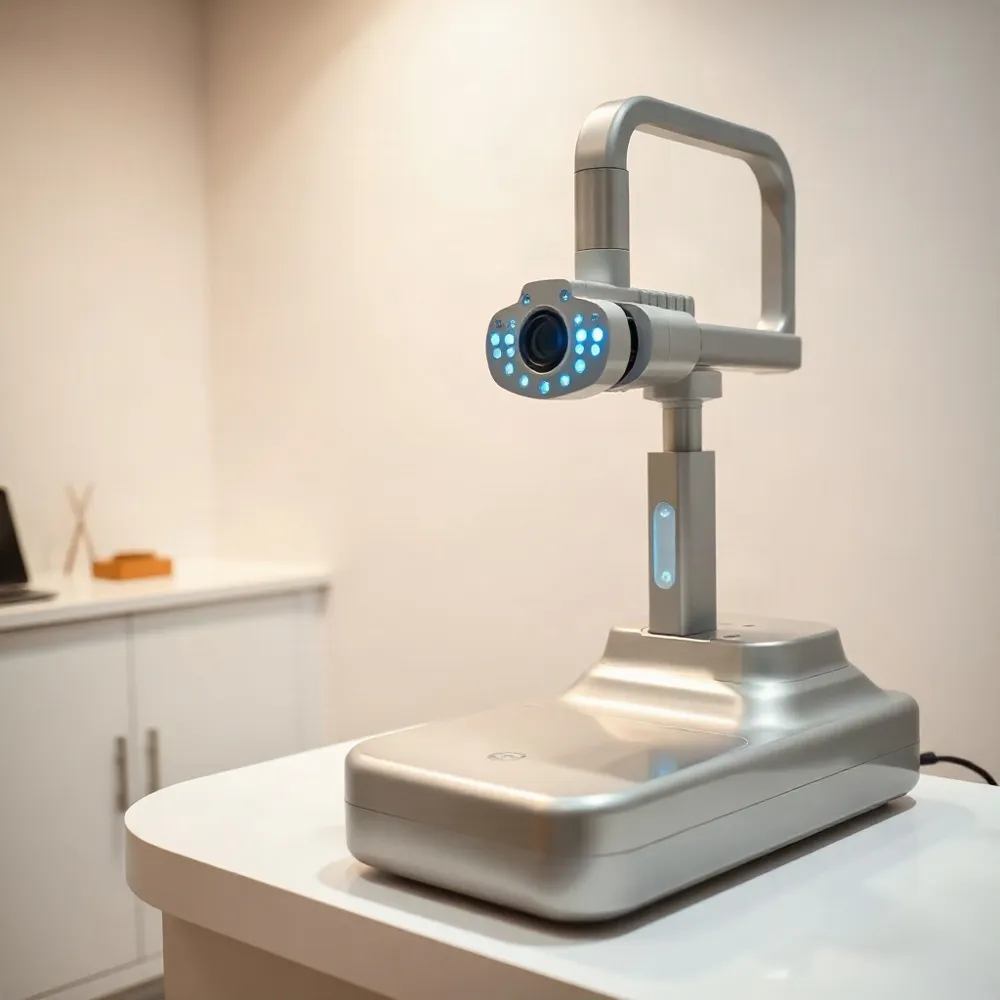
Apple Eye Care in El Paso, TX delivers comprehensive cataract treatment that blends proven surgical techniques with the latest innovations. Modern cataract surgery most commonly uses phacoemulsification—ultrasonic energy breaks the cloudy lens through a 2‑2.5 mm self‑sealing incision—while many surgeons also offer femtosecond laser‑assisted procedures that create precise capsulotomies and soften the lens, reducing ultrasound energy and improving IOL positioning. Advanced intra‑ocular lenses (IOLs) such as monofocal, toric, multifocal, extended‑depth‑of‑focus, and light‑adjustable lenses are available, allowing personalized correction of distance, near, and astigmatism. Apple Eye Care’s patient‑centered approach begins with detailed diagnostic imaging (DRI OCT Triton, IOLMaster 700) to map each eye, followed by thorough counseling on lens options, lifestyle goals, and financial considerations. Post‑operative care includes tailored drop regimens, protective shields, and scheduled follow‑ups, ensuring rapid visual recovery and optimal long‑term outcomes for a brighter future, and the confidence to enjoy everyday activities while maintaining safety standards and peace of mind.
Surgical Techniques, Lens Choices, and Cost
Table: Cataract Surgery Types & Typical Costs
| Surgery Type | Description | Typical Cost (USD/eye) | Common IOL Options |
|---|---|---|---|
| Phacoemulsification (standard) | Ultrasound emulsifies lens through ≤2.5 mm self‑sealing incision; foldable IOL implanted. | $3,000 – $5,000 | Monofocal, Toric, Multifocal, EDOF |
| Femtosecond laser‑assisted phaco | Laser creates precise capsulotomy & lens fragmentation before ultrasound. | + $500 – $1,000 to phaco cost | Same IOL options, often used for premium lenses |
| Extracapsular extraction | Larger incision, manual removal of lens nucleus; less common. | $4,500 – $7,000 | Monofocal, sometimes Toric |
| Manual small‑incision cataract surgery (MSICS) | Small manual incision (≈5 mm) without ultrasound; suitable where phaco unavailable. | $2,500 – $4,500 | Monofocal, Toric |
| Hybrid phaco‑laser (combined) | Uses both laser and phaco for complex cases. | $4,000 – $6,500 | Premium IOLs (Multifocal, EDOF) |
All prices are approximate and may vary by provider and insurance coverage.
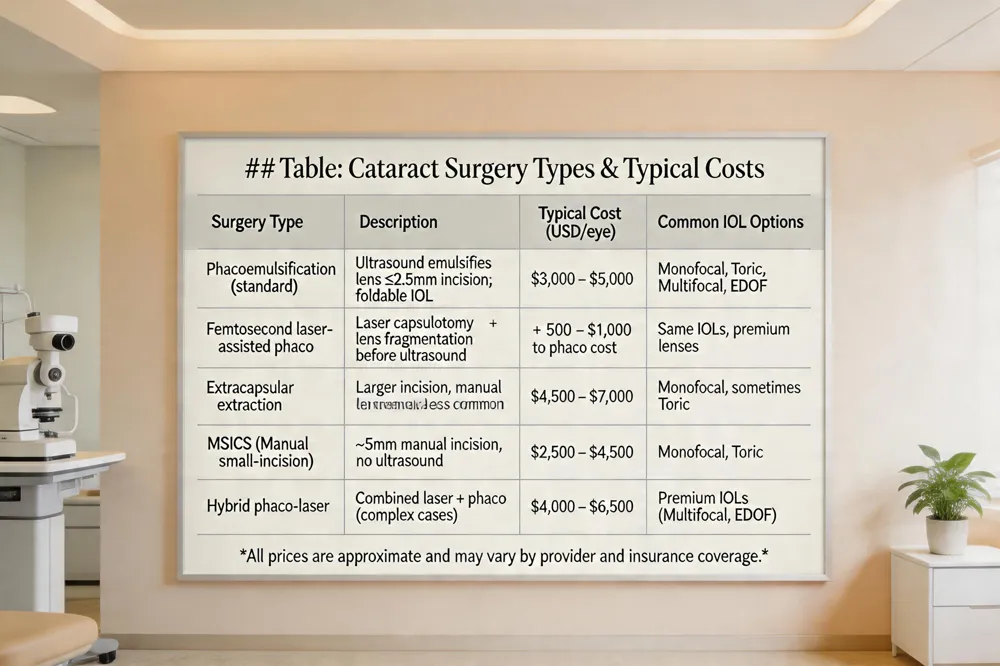 Types of cataract surgery and cost – Phacoemulsification (standard) $3‑5k/eye; femtosecond laser adds $500‑1k and premium IOLs (multifocal, toric, EDOF) $2‑5.5k extra. Extracapsular extraction is rarer and costlier.
Which type is best – Phacoemulsification offers safety, speed, and insurance coverage; laser‑assisted is chosen for precise capsulotomy or premium toric/multifocal lenses.
Most preferred – Monofocal IOL via phacoemulsification, widely covered, reliable distance vision, low glare.
Four types – Phacoemulsification, extracapsular extraction, femtosecond laser‑assisted, manual small‑incision cataract surgery.
Preferred today – Small‑incision phaco with optional femtosecond laser, combined with advanced IOLs for fast healing and minimal astigmatism.
Phacoemulsification – Ultrasound through ≤2.5 mm self‑sealing incision emulsifies lens, foldable IOL implanted; vision improves within 24 h.
Five approaches – Phacoemulsification, extracapsular extraction, femtosecond laser‑assisted, small‑incision manual, hybrid phaco‑laser.
All options are discussed at Apple Eye Care, El Paso, TX, using advanced diagnostics like DRI OCT Triton.
Intra‑ocular Lens Options and Emerging Technologies
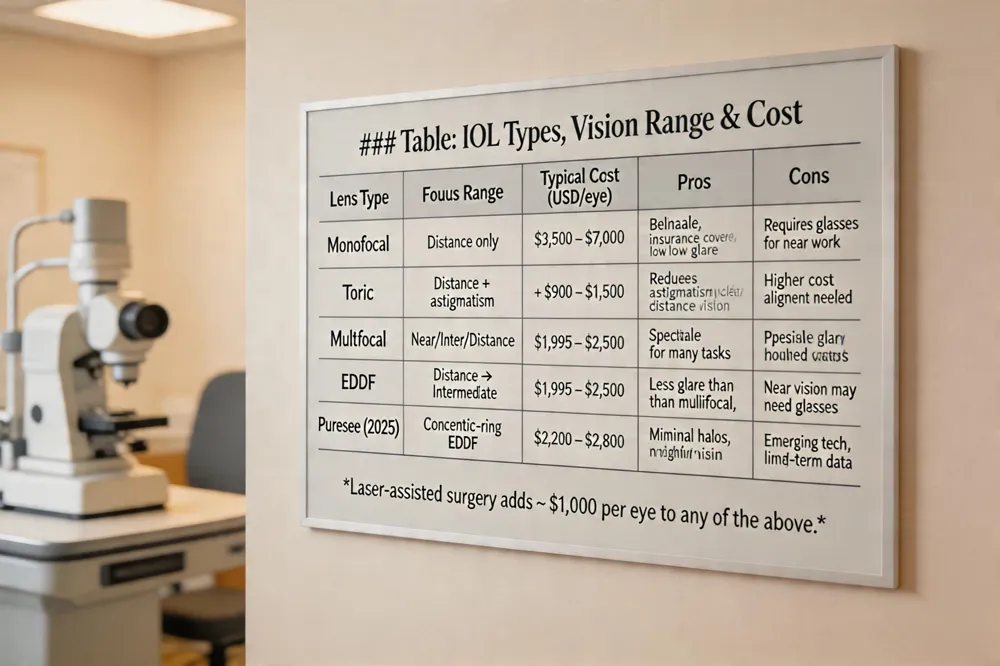
Table: IOL Types, Vision Range & Cost
| Lens Type | Focus Range | Typical Cost (USD/eye) | Pros | Cons |
|---|---|---|---|---|
| Monofocal | Distance only | $3,500 – $7,000 | Reliable, insurance covered, low glare | Requires glasses for near work |
| Toric (monofocal base) | Distance + astigmatism correction | + $900 – $1,500 | Reduces astigmatism, clear distance vision | Higher cost, precise alignment needed |
| Multifocal | Near, intermediate, distance (multiple focal points) | $1,995 – $2,500 (premium) | Spectacle‑independent for many tasks | Possible glare/halos, reduced contrast |
| EDOF (Extended‑Depth‑of‑Focus) | Continuous range from distance to intermediate | $1,995 – $2,500 (premium) | Less glare than multifocal, good intermediate vision | Near vision may still need glasses |
| Puresee (2025) | Concentric‑ring EDOF, glare‑free distance & intermediate | $2,200 – $2,800 (estimated) | Minimal halos, excellent night vision | Emerging technology, limited long‑term data |
Laser‑assisted surgery adds ~ $1,000 per eye to any of the above.
 What is the newest lens for cataract surgery
The Puresee lens, unveiled in 2025, is the latest intra‑ocular lens. It is an extended‑depth‑of‑focus (EDOF) implant with a concentric‑ring design that delivers glare‑free distance and intermediate vision while minimizing halos at night. Most patients achieve distance acuity without glasses, needing only occasional reading glasses for very close work.
What is the newest lens for cataract surgery
The Puresee lens, unveiled in 2025, is the latest intra‑ocular lens. It is an extended‑depth‑of‑focus (EDOF) implant with a concentric‑ring design that delivers glare‑free distance and intermediate vision while minimizing halos at night. Most patients achieve distance acuity without glasses, needing only occasional reading glasses for very close work.
Cataract lens price list At Apple Eye Care, a standard monofocal IOL costs $3,500‑$7,000 per eye out‑of‑pocket. Toric lenses add $900‑$1,500. Premium multifocal or EDOF lenses range $1,995‑$2,500 each. Laser‑assisted surgery adds roughly $1,000 per eye. Insurance typically covers the monofocal lens; the premium‑lens surcharge remains the patient’s expense.
3 types of cataract lenses Monofocal, multifocal, and EDOF lenses are the primary IOL categories. Monofocal lenses provide clear distance vision; multifocal lenses give multiple focal points for near, intermediate, and distance; EDOF lenses create an elongated focus zone for distance and intermediate vision with fewer visual phenomena.
Cataract surgery options pros and cons Monofocal lenses are reliable, covered by insurance, but need glasses for near tasks. Multifocal lenses reduce glasses dependence but may cause glare/halos and are often uncovered. Toric lenses correct astigmatism, offering clear vision without glasses, yet they are costlier and require precise alignment.
What is the new cataract treatment for 2026? In 2026, premium IOLs such as Alcon’s Clareon PanOptix Pro (trifocal) and Vivity/Smart (EDOF) combined with advanced diagnostics (DRI OCT Triton) provide near‑perfect, spectacle‑independent vision, representing the cutting‑edge of cataract care.
Post‑Operative Care: Discharge Instructions and Activity Restrictions
Table: Post‑Op Timeline & Key Recommendations
| Time After Surgery | Recommendation |
|---|---|
| 0‑24 h | Keep eye shield/patch on; avoid rubbing; apply first drop of antibiotic/anti‑inflammatory; wear UV‑blocking sunglasses outdoors. |
| 24‑48 h | Remove patch if instructed; continue drops every 5 min as prescribed; wear shield while sleeping; begin gentle walking. |
| 2‑7 days | Light dusting with long‑handled tools; avoid heavy lifting >10 lb; no swimming, vigorous exercise, or sexual activity. |
| 7‑10 days | Resume normal light household chores; may begin low‑impact exercise (e.g., walking) if comfortable. |
| 10‑14 days | Gradually reintroduce moderate activity; swimming and weight‑training allowed after surgeon’s clearance. |
| 24‑48 h (after visual acuity ≥20/40) | Driving permitted; night driving may require 2‑4 weeks for full comfort. |
| 24 h onward | Commercial flights safe; continue artificial tears, sunglasses, and avoid eye rubbing. |
Contact the clinic immediately for pain, redness, sudden vision loss, or any urgent warning signs.
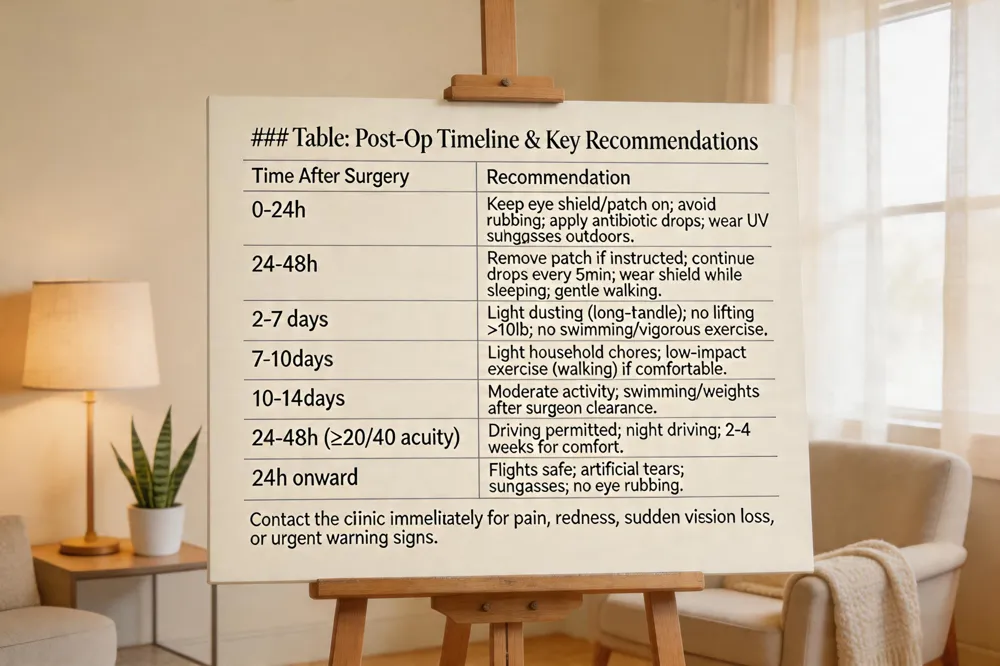 After cataract surgery, keep the eye covered with protective eye shield or patch for 24‑48 hours and never rub it. Wash hands before each drop, place one drop, close the eye for seconds, and wait five minutes before another drop or artificial tear. Wear UV‑blocking sunglasses outdoors and a shield while sleeping; if you must sleep on your side, lie opposite the surgical eye and keep your head elevated. Avoid heavy lifting, bending, vigorous exercise, swimming, and sexual activity for 7‑10 days; walking is allowed after 24 hours. Strenuous activities such as weight‑training, running, or swimming should be postponed for one to two weeks. Driving may resume 24‑48 hours after the surgeon confirms visual acuity of ≥20/40; night driving often requires 2‑4 weeks. Commercial flights are safe after 24 hours, but use artificial tears, sunglasses, and avoid eye rubbing; contact the clinic promptly for any pain, redness, or possible sudden vision loss (urgent warning signs).
Daily Living: Nutrition, Household Tasks, and Lifestyle Adjustments
Table: Daily‑Living Guidance by Post‑Op Day
| Days Post‑Op | Diet | Cooking | Housework | Physical Activity |
|---|---|---|---|---|
| 0‑2 | Light, low‑sodium, low‑sugar, low‑fat; avoid salty soups, fried foods, alcohol, caffeine, tobacco. | Cold meals, simple assembly (sandwiches, salads). | Rest eyes; avoid dust; no sweeping. | Minimal movement; keep head elevated when sleeping. |
| 3‑5 | Continue light diet; add soft cooked vegetables, soups (room temperature). | Gentle chopping with a sturdy knife; avoid hot steam. | Light dusting with long‑handled duster; avoid bending. | Short walks; no lifting >5 lb. |
| 6‑14 | Gradually reintroduce normal balanced meals; stay hydrated. | Steaming, boiling, baking; avoid deep‑frying and strong fumes; wear protective glasses. | Light sweeping, laundry; vacuum after 2‑week follow‑up. | Light household chores; resume low‑impact exercise (e.g., stationary bike). |
| 15‑30 | Return to regular diet; maintain eye‑healthy nutrients (Omega‑3, lutein). | Full cooking resume; use ventilation. | Full house cleaning; vacuuming, mopping. | Moderate exercise; weight‑training only after surgeon’s clearance. |
Strict adherence to prescribed eye drops and follow‑up appointments accelerates recovery.
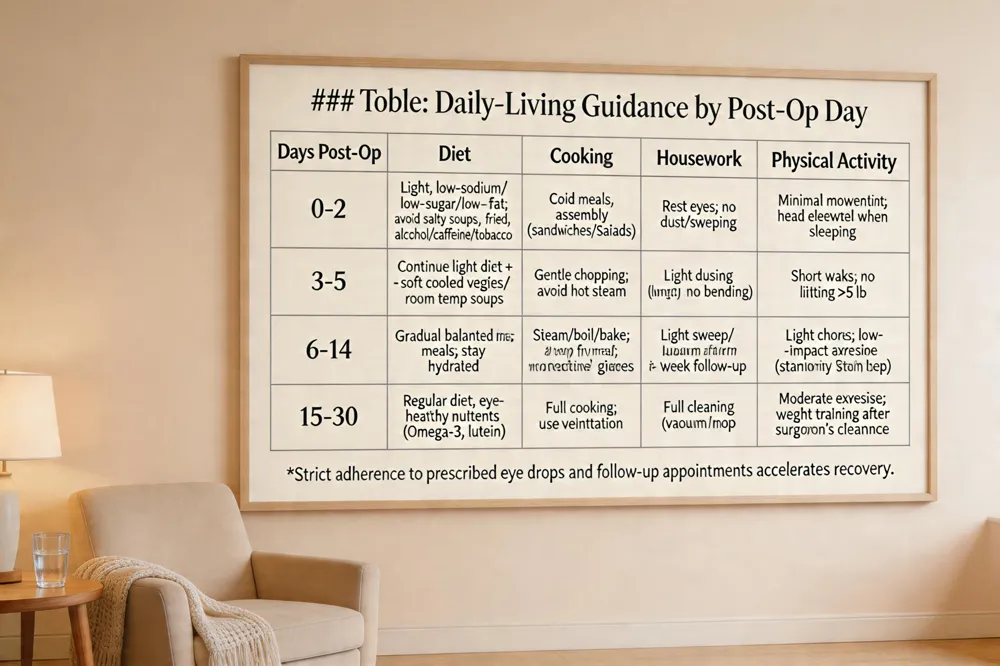 Post‑operative diet should be light, low‑sodium, low‑sugar, and low‑fat; avoid salty soups, fried foods, sugary drinks, alcohol and caffeine, and spicy or tobacco products that can raise intra‑ocular pressure or inflammation. Cooking for the first 1‑2 weeks is limited to cold meals or simple assembly; by day 3‑5 begin gentle chopping, and by week 2 resume steaming, boiling, or baking—avoid deep‑frying and bright fumes, wear protective glasses, and keep the kitchen ventilated. Housework: rest the eyes for 48 hours, then light dusting with long‑handled tools days 3‑7; light sweeping and laundry in week 2; vacuuming or deep cleaning after the ‑up visit, typically by weeks 3‑4. The fastest recovery comes from strict adherence to prescribed antibiotic/anti‑inflammatory drops, eye protection, avoid rubbing, limiting heavy lifting or vigorous exercise for at least a week, resting the eyes early, and keeping all follow‑up appointments.
Managing Symptoms, Follow‑Up, and Long‑Term Eye Health
Table: Common Post‑Op Symptoms, Follow‑Up Schedule & Management
| Symptom / Follow‑Up | Typical Timing | Management |
|---|---|---|
| Photophobia (light sensitivity) | Immediate‑first few days | Wear UV‑blocking sunglasses; artificial tears. |
| Mild redness, gritty sensation | First 1‑2 weeks | Continue anti‑inflammatory drops; avoid rubbing. |
| Fluctuating acuity, halos, glare | First month (as IOL settles) | Reassess at 1‑month visit; consider YAG laser if persistent capsular opacification. |
| Posterior capsular opacification (PCO) | Months‑years later | YAG laser capsulotomy if vision declines. |
| Follow‑up visits | 1‑2 days, 1 week, 1 month, then yearly | Dilated eye exam, IOP check, retinal health assessment. |
| Contraindications to surgery | Pre‑operative evaluation | Uncontrolled systemic disease, active ocular infection, advanced retinal/corneal pathology. |
| Emerging non‑surgical therapies | Research stage (2026) | Chelation‑based eye drops (EDTA), sterol‑based compounds – awaiting larger trials and FDA approval. |
Any sudden vision loss, severe pain, or rapidly increasing redness warrants immediate urgent care.
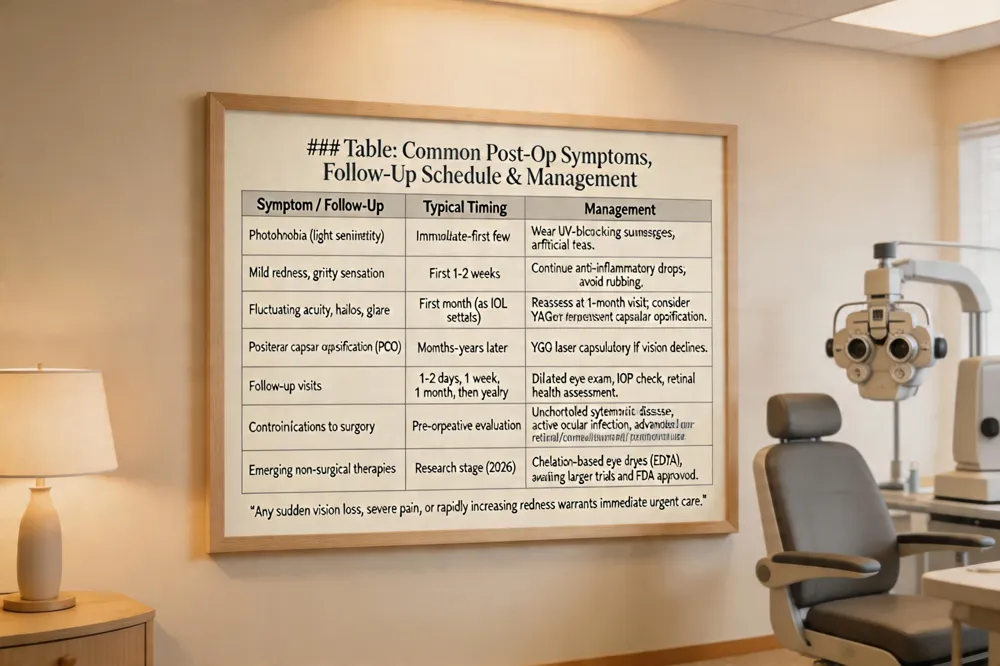 After cataract surgery patients most frequently notice increased light sensitivity (photophobia), which often leads them to wear sunglasses and use artificial tears; mild redness, gritty sensation, and temporary blurry vision are also common. Early vision problems include halos, glare, and fluctuating acuity as the new IOL settles, while posterior capsular opacification may develop months later and require YAG laser treatment. Annual dilated eye exams remain essential—first visits occur at 1‑2 days, 1 week, and 1 month post‑op, then yearly check‑ups monitor retinal health, intra‑ocular pressure, and any emerging conditions such as glaucoma or macular degeneration. Contraindications to surgery include uncontrolled systemic disease, advanced retinal or corneal pathology, active infection, or poor visual benefit from lens removal. Non‑surgical advances are exploring chelation‑based eye drops (e.g., EDTA formulations) and sterol‑based compounds that may slow or modestly improve early cataracts, though they await larger trials and FDA approval.
Key Takeaways and Next Steps
Cataract surgery in the U.S. is most often performed with phacoemulsification, a tiny self‑sealing corneal incision and ultrasonic lens removal. For patients seeking greater precision, femtosecond laser‑assisted surgery creates exact capsulotomies and softens the lens before phaco. Intra‑ocular lenses (IOLs) range from monofocal (single distance) to multifocal, extended‑depth‑of‑focus, toric (astigmatism‑correcting), and light‑adjustable designs, with premium options often not covered by Medicare. Recovery best practices include wearing a protective shield at night, using prescribed antibiotic and anti‑inflammatory drops for 1‑2 weeks, avoiding rubbing, heavy lifting, swimming, and vigorous exercise for at least 7‑10 days, and scheduling follow‑up visits. For personalized IOL counseling and advanced imaging (DRI OCT Triton), call Apple Eye Care in El Paso, TX at (915) 555‑1234.