The Power of a Full‑Scope Eye Check‑Up
A comprehensive eye exam goes far beyond a simple vision screen. It begins with a detailed medical and visual‑history interview, followed by visual‑acuity testing, refraction, and assessments of eye‑muscle coordination, depth perception, and color vision. Advanced tools such as slit‑lamp examination, tonometry for intra‑ocular pressure, and high‑resolution OCT imaging (e.g., the DRI OCT Triton) allow the clinician to inspect the cornea, lens, retina, and optic nerve for early signs of cataracts, glaucoma, macular degeneration, or diabetic retinopathy. Detecting these conditions early protects sight and can reveal systemic diseases like diabetes or hypertension before symptoms appear. Apple Eye Care in El Paso embraces a family‑focused model: every member—from infants to seniors—receives age‑appropriate testing, personalized explanations, and a care plan that fits lifestyle. The practice’s compassionate team uses state‑of‑the‑art technology to ensure each visit safeguards both vision and overall health. Regular follow‑up appointments keep the eye health on track and adapt treatment as needs change.
Understanding the Comprehensive Eye Exam
Basic vs. Comprehensive Eye Exam
| Aspect | Basic Exam | Comprehensive Exam |
|---|---|---|
| Primary focus | Visual acuity & simple refraction | Full health assessment, retina & optic nerve evaluation |
| Typical tests | Snellen chart, quick refraction | History, visual acuity, phoropter refraction, eye‑muscle coordination, depth perception, color vision, peripheral fields, pupil dilation, OCT, slit‑lamp, tonometry |
| Detectable conditions | Refractive errors only | Glaucoma, macular degeneration, diabetic retinopathy, cataracts, binocular‑vision problems |
| Cost (out‑of‑pocket) | $20‑$50 (often covered by vision plan) | $80‑$150 (medical insurance may cover; co‑pay $10‑$30) |
| Insurance coverage | Vision‑only plans | Medical insurance if medically necessary; vision plans for prescription updates |
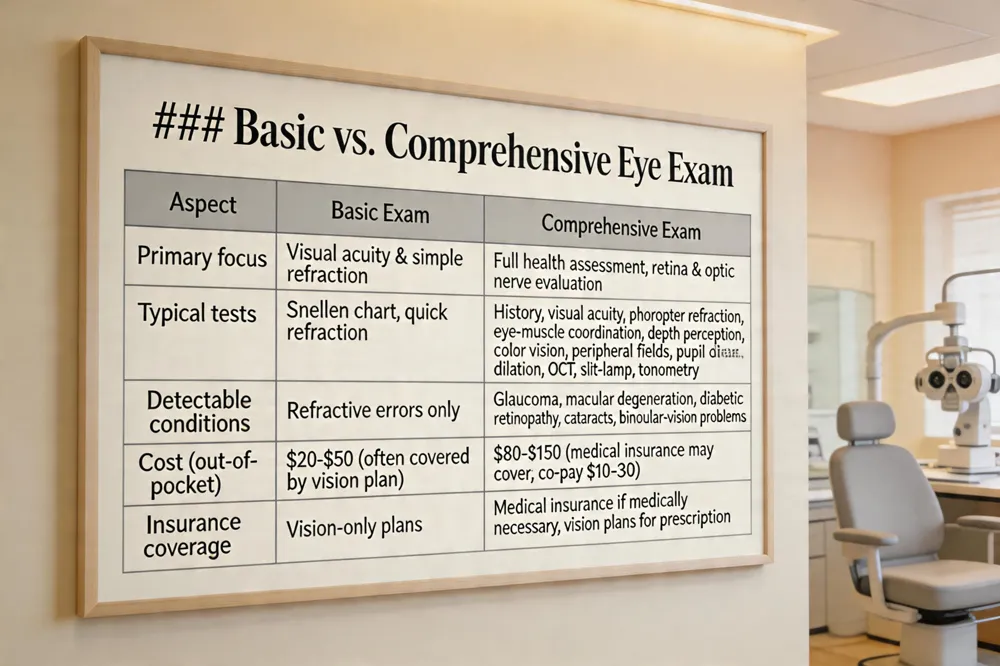 A comprehensive eye exam goes far beyond a quick visual‑acuity check. It begins with a detailed health and vision history, then measures visual acuity, conducts refraction with a phoropter, and evaluates eye‑muscle coordination, depth perception, color vision, and peripheral fields. Advanced elements such as pupil dilation allow the clinician to examine the retina, optic nerve, and lens directly. Modern practices like Apple Eye Care in El Paso employ the DRI OCT Triton, a high‑resolution optical‑coherence tomography system that creates cross‑sectional images of the retina and optic nerve. OCT can reveal the earliest signs of glaucoma, macular degeneration, and diabetic retinopathy—conditions that often show no symptoms until vision is compromised. Because a basic exam typically checks only distance vision and provides a simple prescription, it can miss refractive errors, binocular‑vision problems, and underlying eye disease.
What is the difference between a basic and a comprehensive eye exam?
A basic eye exam focuses mainly on visual acuity and a simple refraction to determine your current prescription. A comprehensive eye exam expands the evaluation to include a full health assessment of the eyes, often with pupil dilation to examine the retina and optic nerve. It also measures intra‑ocular pressure, checks eye‑muscle function and peripheral vision, and uses advanced imaging such as OCT to detect early signs of glaucoma, macular degeneration, or diabetic retinopathy. Additional tests may include slit‑lamp examination of the cornea, eyelids, and tear film, as well as depth‑perception and color‑vision screening. This broader set of exams allows the optometrist to identify and manage eye diseases before they affect vision.
Is a comprehensive eye exam covered by insurance?
Yes, a comprehensive eye exam can be covered by insurance, but coverage depends on the type of plan you have and the reason for the exam. If the exam is deemed medically necessary—such as to diagnose or manage glaucoma, cataracts, diabetic retinopathy, or other eye diseases—most major health‑insurance policies, including those required under the Affordable Care Act, will pay for it. Routine exams that are solely for updating a glasses or contact‑lens prescription are typically covered by a separate vision‑insurance policy rather than medical insurance. Apple Eye Care works with a wide range of both medical and vision insurers and will verify your benefits before your visit.
Comprehensive eye exam cost
At Apple Eye Care a comprehensive eye exam typically costs between $80 and $150 out‑of‑pocket, depending on the extent of testing required. If you have vision insurance, most plans cover the exam and the co‑pay is usually $10 to $30. For patients without insurance, the price may be higher if advanced diagnostics such as DRI OCT Triton are included, but the practice strives to keep fees transparent and affordable. Apple Eye Care also offers discounts for seniors, students, and military personnel, and most patients can request a personalized quote before the visit. Scheduling an appointment in advance helps ensure you receive the full range of services at the expected price.
Pediatric Eye Care: What Parents Should Know
Pediatric Eye Exam Schedule & Key Points
| Age / Milestone | Recommended Exam | What’s Evaluated |
|---|---|---|
| 6 months | First comprehensive exam | Visual acuity, eye alignment, tracking, health of cornea/lens/retina |
| 3 years | Second exam | Same as above + depth perception, color vision |
| Before kindergarten (≈5 yr) | Third exam | Early detection of amblyopia, strabismus, myopia |
| Yearly after | Ongoing exams | Vision, eye‑muscle function, peripheral fields, OCT if needed |
20‑20‑20 Rule for Kids – Every 20 min → look at something ≥20 ft away for ≥20 sec.
Common Conditions – Amblyopia, strabismus, myopia (up to 42 % of school‑aged kids).
Cost – Flat‑rate fee (no insurance required); discounts for seniors, students, military.
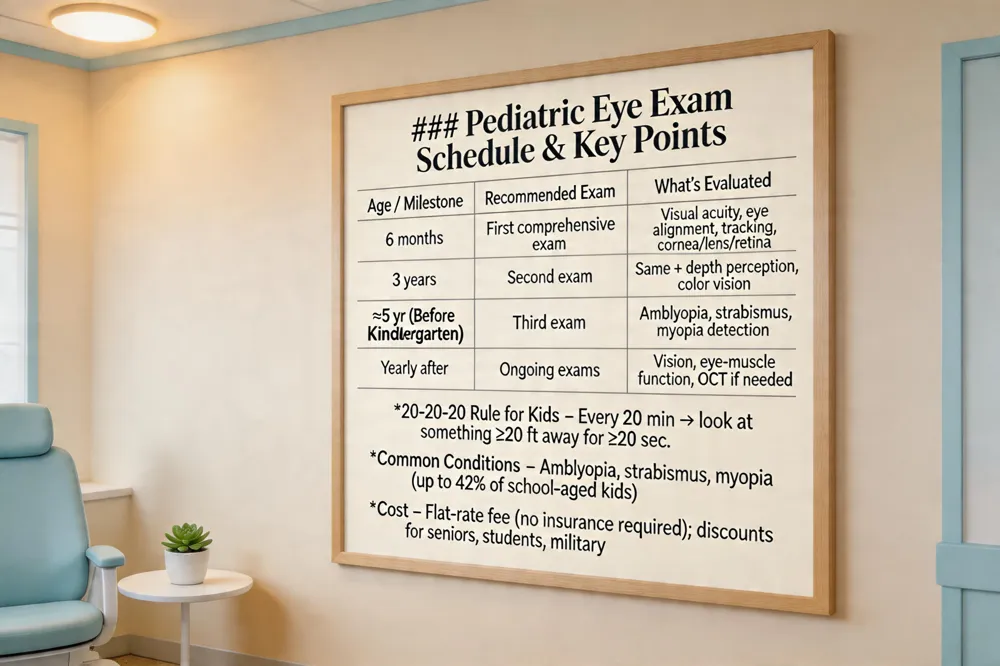 A comprehensive eye exam should begin by age six months, repeat at three years, and be performed again before kindergarten; after that, yearly exams are recommended through school age. These visits evaluate visual acuity, eye alignment, tracking, depth perception, and the health of the cornea, lens, retina, and optic nerve. Common childhood conditions include amblyopia (lazy eye), strabismus (crossed eyes), and myopia, which now affect up to 42 % of school‑aged children. Early detection through age‑appropriate testing—symbol charts for preschoolers, Snellen charts for school‑aged kids, and stereopsis, color‑vision, and retinoscopy assessments—allows timely treatment such as glasses, vision therapy, or myopia‑management options like low‑dose atropine or orthokeratology.
What is the 20‑20‑20 rule for kids? The 20‑20‑20 rule is a simple break‑time technique designed to protect children’s eyes during prolonged screen use or close‑up work. Every 20 minutes, have your child pause and focus on an object that is at least 20 feet away for a minimum of 20 seconds. This brief pause lets the eye‑muscles relax, restores normal blinking, and helps keep the tear film healthy, reducing eye strain and headaches. Parents can turn the break into a fun activity—like spotting distant cars, trees, or playing a quick “I spy” game—to keep kids engaged. Using timers, apps, or gentle reminders makes it easy to incorporate the rule into daily routines and supports long‑term visual comfort.
Can a free eye test detect glaucoma? Yes, a free eye test can identify early signs of glaucoma, but it is a screening rather than a definitive diagnosis. Most free or low‑cost screenings measure intra‑ocular pressure and may include a quick optic‑nerve check, which can flag elevated risk. If the results are abnormal, a comprehensive eye exam by an eye doctor is needed to confirm glaucoma and determine treatment. Programs such as EyeCare America, community health centers, and insurance‑covered visits at Apple Eye Care provide free or reduced‑price screenings for high‑risk individuals. Ultimately, a full exam with advanced imaging (e.g., OCT) is required for a definitive glaucoma diagnosis.
Eye exam for kids with no insurance Apple Eye Care offers pediatric eye exams at a flat‑rate fee with no insurance required, so families can get a thorough vision screening without unexpected costs. We accept cash, credit cards, and provide flexible payment plans to fit any budget. Our staff can also help you apply for local assistance programs such as VSP Eyes of Hope, Lions Clubs, and community health‑center vouchers that may cover part or all of the exam. If you need additional support, we can connect you with statewide resources like EyeCare America or the National Eye Institute’s low‑cost eye‑care listings. Schedule an appointment today and let Dr. Stephen Applebaum’s compassionate team ensure your child’s eyes stay healthy and clear.
Pediatric eye exam near me Apple Eye Care in El Paso, TX, provides comprehensive pediatric eye exams for children of all ages. Our family‑focused practice uses state‑of‑the‑art technology—including the DRI‑OCT Triton —to accurately assess vision and detect early eye conditions. We tailor each exam to a child’s developmental stage, ensuring a comfortable and thorough experience. Our experienced team, led by Dr. Stephen Applebaum, can diagnose and manage issues such as nearsightedness, amblyopia, strabismus, and dry eye. Schedule an appointment today to give your child the clear vision they need for learning and play.
Adult and Senior Eye Health
Exam Frequency & Risk Factors by Age
| Age Group | Recommended Frequency | Risk Factors Prompting More Visits |
|---|---|---|
| 18‑39 (low‑risk) | Every 2 years | Family history of eye disease, diabetes, hypertension, high/refractive error, contact‑lens wear, prior surgery |
| 18‑39 (high‑risk) | Annually | Same as above + new visual symptoms |
| 40‑64 (low‑risk) | Every 2 years | Same risk factors as above |
| 40‑64 (high‑risk) | Annually | Diabetes, hypertension, glaucoma family history, cataract surgery, etc. |
| 65+ | Annually (standard) | Age‑related changes, chronic systemic disease |
Systemic Disease Detection – Dilated retinal imaging can reveal early diabetes (micro‑aneurysms) and hypertension (arteriolar narrowing).
Age‑Related Conditions – Cataracts, AMD, glaucoma – screened with OCT, tonometry, slit‑lamp.
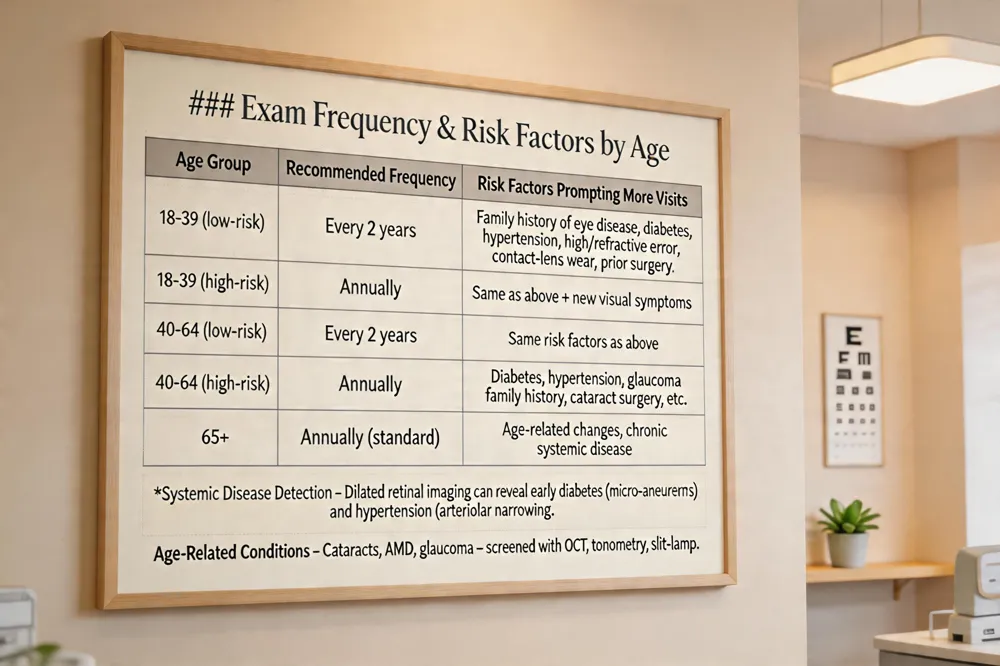 Regular comprehensive eye exams are essential for adults and seniors because they catch vision problems early and can reveal systemic illnesses.
Exam frequency – Ages 18‑39 should be examined every two years if asymptomatic and low‑risk, while those with risk factors (family history of eye disease, diabetes, hypertension, high or progressive refractive error, contact‑lens wear, or prior eye surgery) need annual exams. Adults 40‑64 are advised to have an eye exam every two years, but yearly visits are recommended for the same risk groups and for anyone with new visual symptoms. Once a person reaches 65 years or older, an annual exam is the standard of care to monitor age‑related changes and chronic conditions.
Risk factors prompting more frequent visits – A family history of glaucoma, cataracts, or macular degeneration, systemic diseases such as diabetes or high blood pressure, and personal ocular history (e.g., prior cataract surgery, contact‑lens complications) all warrant closer monitoring.
Systemic disease detection – The eye is a window to overall health. Dilated retinal imaging and optic‑nerve assessment can uncover early signs of diabetes (micro‑aneurysms, retinal hemorrhages) and hypertension (arteriolar narrowing, copper‑wire changes). Detecting these changes allows physicians to intervene before organ damage occurs.
Age‑related ocular conditions – Cataracts become common after age 40 and can be identified during slit‑lamp exams. Age‑related macular degeneration (AMD) and glaucoma are screened with OCT imaging (e.g., DRI OCT Triton) and intra‑ocular pressure testing. Early identification of cataracts, AMD, or glaucoma enables timely treatment—such as cataract surgery, anti‑VEGF injections, or pressure‑lowering therapy—preserving vision and quality of life for adults and seniors.
Technology That Makes a Difference
Key Technologies Used at Apple Eye Care
| Technology | Primary Use | Clinical Benefit |
|---|---|---|
| DRI OCT Triton | High‑resolution retinal & optic‑nerve imaging | Detects early macular degeneration, diabetic retinopathy, glaucoma |
| n | Slit‑lamp examination | Magnified view of cornea, iris, lens |
| Tonometry | Intra‑ocular pressure measurement | Screens for glaucoma risk |
| Corneal topography | Surface mapping | Precise contact‑lens fitting, keratoconus detection |
| Tear‑film break‑up time & meibography | Dry‑eye assessment | Guides personalized dry‑eye therapy |
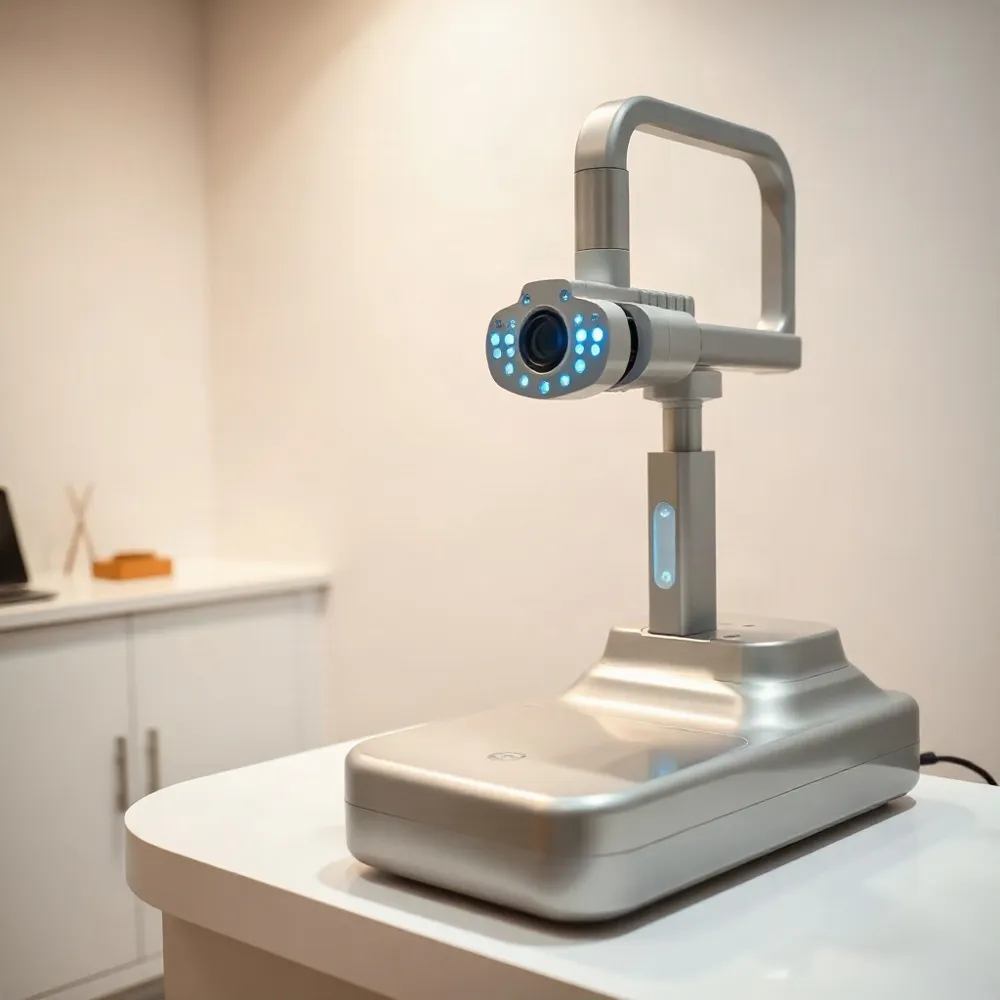
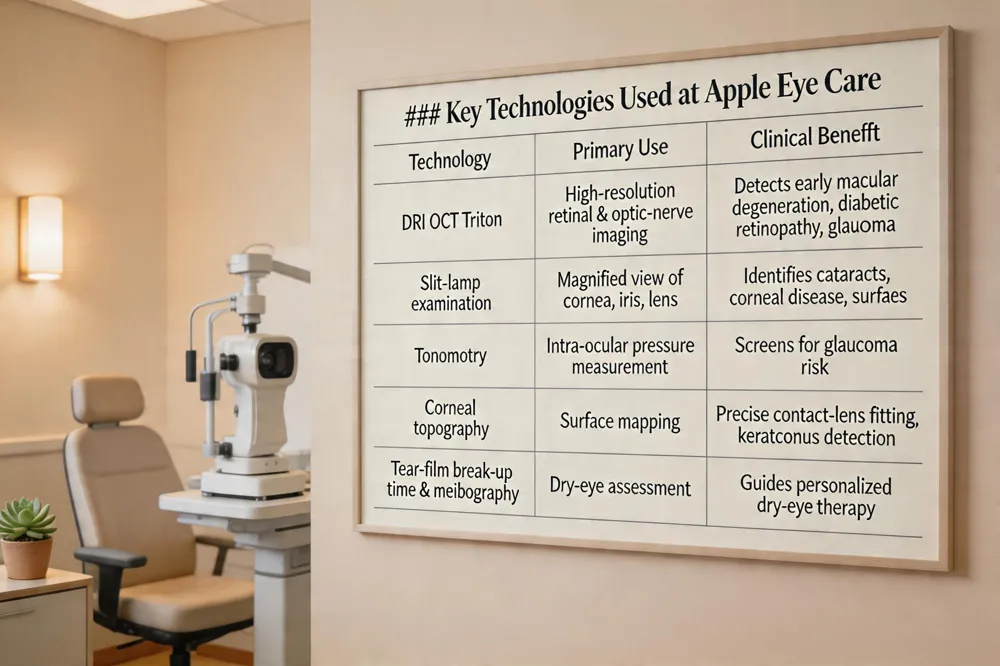 Apple Eye Care’s use of the DRI OCT Triton provides high‑resolution retinal imaging that can spot early macular degeneration, diabetic retinopathy, and glaucoma changes before symptoms appear. Complementary slit‑lamp examinations give a magnified view of the cornea, iris, and lens, while tonometry measures intra‑ocular pressure to flag glaucoma risk. Corneal topography maps the eye’s surface for precise contact‑lens fitting and keratoconus detection. Advanced dry‑eye diagnostics, such as tear‑film break‑up time and meibography, guide personalized treatment plans that may include prescription drops, punctal plugs, or in‑office therapies. Finally, the same OCT and imaging tools monitor cataract formation and optic‑nerve health, enabling timely intervention and tailored management for each patient.
Scheduling, Payments, and Convenience
Scheduling & Payment Options
| Feature | Details |
|---|---|
| Insurance verification | Done ahead of appointment; works with medical & vision carriers |
| Exam cost | $80‑$150 (comprehensive); co‑pay $10‑$30 with vision insurance |
| Discounts | Seniors, students, military personnel |
| Payment methods | Cash, checks, credit cards, Android Pay, CareCredit financing |
| Appointment options | In‑person, urgent‑care slots, tele‑health follow‑up |
| Patient portal | View results, set reminders, request quotes |
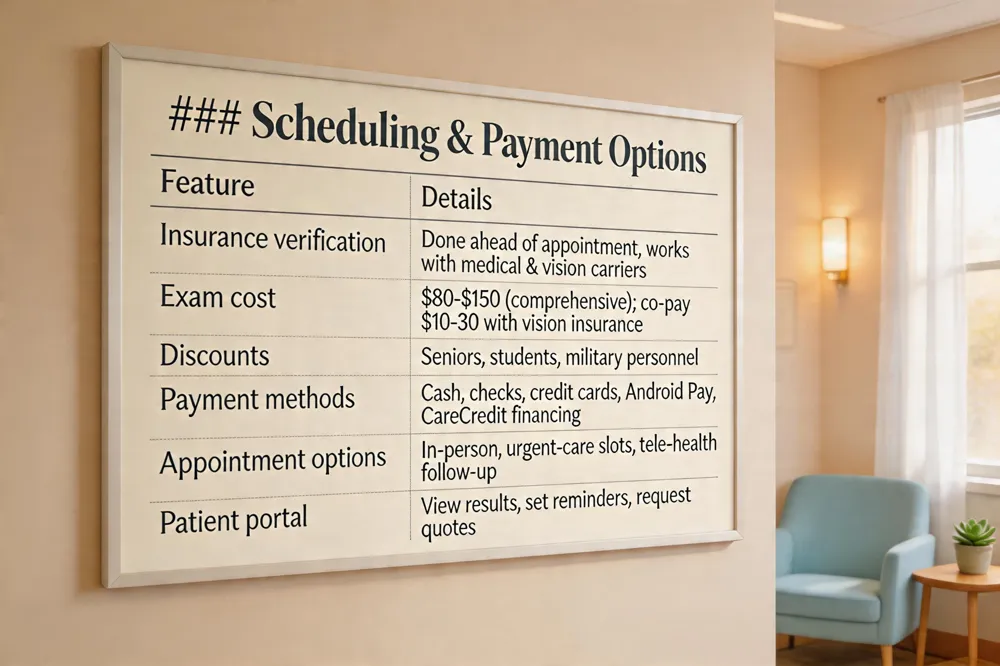 Apple Eye Care verifies insurance ahead of time, working with a wide range of medical and vision carriers and confirming benefits before your appointment. Routine exams that are medically necessary—such as screening for glaucoma, cataracts, or diabetic retinopathy—are typically covered by health insurance, while vision‑only plans usually cover prescription updates. The practice offers a flat‑rate fee of $80‑$150 for a comprehensive exam, with co‑pays of $10‑$30 when vision insurance is applied; seniors, students, and military personnel receive discounts. Patients can book, choose urgent‑care slots, or use tele‑health consultations for follow‑up questions. Flexible payment includes credit cards, Android Pay, and finance plans. The portal lets you view results and set reminders. Apple Eye Care accepts cash, checks, and CareCredit financing for procedures. Credit card and Android Pay accepted.
Protecting Vision Across Generations
Regular comprehensive eye exams are the cornerstone of family eye health. By reviewing medical history, measuring visual acuity, testing refraction, and dilating the pupils, optometrists detect refractive errors, glaucoma, cataracts, diabetic retinopathy, and even systemic conditions such as hypertension and diabetes before symptoms arise. Advanced diagnostic tools like the DRI OCT Triton provide high‑resolution retinal and optic‑nerve images, revealing early macular degeneration or nerve damage that a simple vision screen would miss. Apple Eye Care in El Paso combines this state‑of‑the‑art imaging with a family‑focused, compassionate approach. With flexible scheduling, tele‑health options, and most major vision‑insurance acceptance, the practice ensures every age group—from infants to seniors—can access timely, personalized eye care. On‑site optical shop offers frames, lenses, and protective eyewear today.