Why Glaucoma Management Matters Today
Glaucoma is often called the “silent thief of sight” because it damages the optic nerve without warning, leading to irreversible peripheral‑vision loss and, eventually, central blindness. Early detection—through comprehensive dilated exams, visual‑field testing, and high‑resolution OCT such as the DRI OCT Triton—allows clinicians to spot subtle nerve‑fiber thinning before functional decline occurs. Advances in imaging, AI‑driven risk prediction, and home‑monitoring devices are sharpening this early‑warning system. Meanwhile, a new generation of therapies is moving beyond pressure‑lowering drops. Neuroprotective implants that secrete ciliary neurotrophic factor, gene‑editing of astrocytes, sustained‑release drug‑delivery implants, and refined laser and MIGS procedures now offer patients a “belt‑and‑suspenders” strategy that protects remaining nerve cells while controlling intraocular pressure. These innovations promise slower progression and improved quality of life.
Neuroprotective and Regenerative Therapies on the Horizon
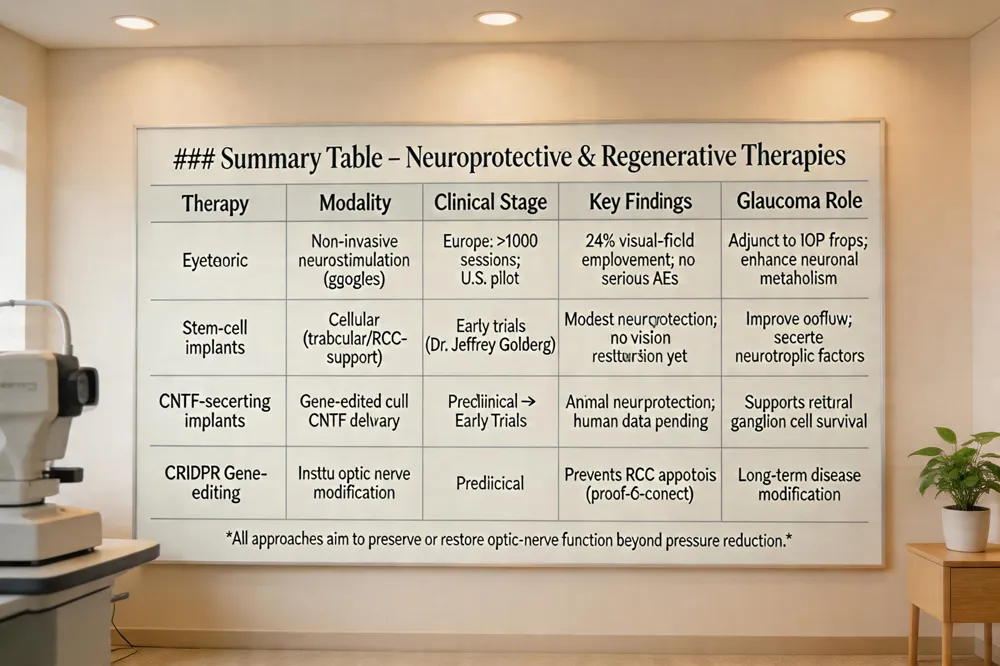
Summary Table – Neuroprotective & Regenerative Therapies
| Therapy | Modality | Clinical Stage | Key Findings | Potential Role in Glaucoma Management |
|---|---|---|---|---|
| Eyetronic | Non‑invasive neurostimulation via goggles | Completed >1,000 patient sessions in Europe; U.S. pilot underway | 24 % average improvement in visual‑field scores; no serious adverse events | Adjunct to IOP‑lowering drops; may enhance neuronal metabolism |
| Stem‑cell‑engineered implants | Cellular therapy (trabecular‑meshwork‑like or RGC‑supporting cells) | Early‑phase human trials (Dr. Jeffrey Goldberg) | Modest neuroprotective effects; no definitive vision restoration yet | May improve outflow & secrete neurotrophic factors |
| CNTF‑secreting implants | Gene‑edited cell‑based delivery of ciliary neurotrophic factor | Preclinical → early clinical trials | Demonstrated neuroprotection in animal models; human data pending | Directly supports retinal ganglion cell survival |
| Gene‑editing (CRISPR‑based) | In‑situ modification of optic‑nerve cells | Preclinical | Proof‑of‑concept for preventing RGC apoptosis | Long‑term disease modification potential |
All approaches aim to preserve or restore optic‑nerve function beyond pressure reduction.
 Eyetronic therapy review
Eyetronic is a non‑invasive neurostimulation protocol that delivers gentle alternating electrical pulses to the optic nerve via custom goggles. In Europe, >1,000 patients completed ten 60‑minute sessions on consecutive business days, achieving an average 24 % improvement in visual‑field scores without serious adverse events. A U.S. pilot led by Dr. Sunita Radhakrishnan is evaluating the same regimen for patients whose disease progresses despite adequate intra‑ocular pressure (IOP) control. Because it works on neuronal metabolism rather than pressure, Eyetronic can be combined with standard drops and is being explored at forward‑thinking practices such as Apple Eye Care in El Paso.
Eyetronic therapy review
Eyetronic is a non‑invasive neurostimulation protocol that delivers gentle alternating electrical pulses to the optic nerve via custom goggles. In Europe, >1,000 patients completed ten 60‑minute sessions on consecutive business days, achieving an average 24 % improvement in visual‑field scores without serious adverse events. A U.S. pilot led by Dr. Sunita Radhakrishnan is evaluating the same regimen for patients whose disease progresses despite adequate intra‑ocular pressure (IOP) control. Because it works on neuronal metabolism rather than pressure, Eyetronic can be combined with standard drops and is being explored at forward‑thinking practices such as Apple Eye Care in El Paso.
Latest news on glaucoma cure with stem cells Stem‑cell approaches remain experimental but promising. Adult‑derived or induced‑pluripotent stem cells can be programmed into trabecular‑meshwork‑like cells to improve outflow or into retinal‑ganglion‑cell‑supporting cells that secrete neurotrophic factors. Dr. Jeffrey Goldberg’s lab has begun early‑phase human trials of stem‑cell‑engineered implants and reports modest neuroprotective effects, though no definitive vision restoration yet. Unregulated “stem‑cell injection” trials lack proper controls and raise safety concerns, underscoring that a true cure is still years away.
How close are we to a cure for glaucoma Current care—drops, laser, surgery—effectively lowers IOP but cannot reverse optic‑nerve loss. Emerging sustained‑release implants, gene‑editing, neuroprotective agents (e.g., CNTF‑secreting implants), and AI platforms are accelerating progress. While a definitive cure remains elusive, the convergence of pressure‑lowering and neuro‑restorative strategies suggests functional vision recovery could become feasible within the next decade.
New glaucoma treatment 2026 By 2026, AI platforms will automatically flag progression from OCT and fundus images; home‑monitoring devices (portable tonometers, VR visual‑field systems, handheld OCT) will enable continuous IOP and retinal health tracking. Intracameral sustained‑release implants (e.g., iDose, Durysta) will provide months‑long medication without drops. Together, these technologies promise earlier detection, better adherence, and the potential for neuro‑protective or regenerative outcomes, aligning with Apple Eye Care’s commitment to cutting‑edge, personalized glaucoma management.
AI‑Driven Imaging, Home Monitoring, and Sustained‑Release Implants
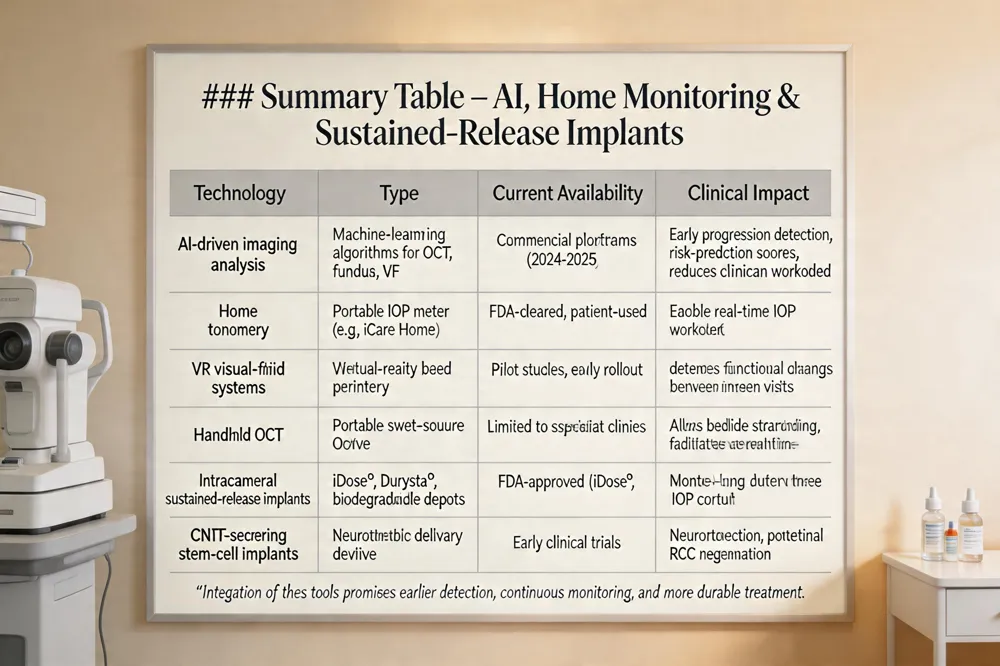
Summary Table – AI, Home Monitoring & Sustained‑Release Implants
| Technology | Type | Current Availability | Clinical Impact |
|---|---|---|---|
| AI‑driven imaging analysis | Machine‑learning algorithms for OCT, fundus, VF | Commercial platforms (2024‑2025) | Early progression detection, risk‑prediction scores, reduces clinician workload |
| Home tonometry | Portable IOP meter (e.g., iCare Home) | FDA‑cleared, patient‑used | Enables real‑time IOP trends; improves adherence to therapy |
| VR visual‑field systems | Virtual‑reality based perimetry | Pilot studies, early rollout | Home VF testing, detects functional changes between visits |
| Handheld OCT | Portable swept‑source OCT device | Limited to specialist clinics | Allows bedside structural imaging, facilitates tele‑medicine |
| Intracameral sustained‑release implants | iDose®, Durysta®, biodegradable depots | FDA‑approved (iDose®, Durysta) and investigational (new depots) | Months‑long drug delivery, reduces drop burden, stable IOP control |
| CNTF‑secreting stem‑cell implants | Neurotrophic delivery device | Early clinical trials | Neuroprotection, potential RGC regeneration |
Integration of these tools promises earlier detection, continuous monitoring, and more durable treatment.
 Advances in glaucoma
Recent advances are reshaping detection, monitoring, and treatment. Artificial‑intelligence (AI) algorithms now analyze OCT scans, fundus photographs, and visual‑field data with expert‑level accuracy, flagging early progression and providing risk‑prediction scores. Remote monitoring tools — home tonometers, virtual‑reality visual‑field platforms, and handheld OCT devices — allow patients to track intra‑ocular pressure (IOP) and retinal health between visits, improving adherence and enabling earlier intervention. Sustained‑release drug‑delivery implants such as iDose, Durysta, and newer biodegradable depots deliver continuous pressure‑lowering medication for months, reducing reliance on daily drops. Emerging neuroprotective strategies, including CNTF‑secreting stem‑cell implants and gene‑edited astrocyte therapies, aim to preserve or even restore optic‑nerve function, addressing the unmet need beyond pressure control.
New glaucoma treatment 2026
In 2026 AI platforms automatically detect progression from imaging, while tele‑medicine devices provide real‑time IOP and visual‑field data. Intracameral implants and polymeric depots offer months‑long drug release, and neuro‑enhancement approaches are entering early clinical trials, promising personalized, durable care.
Latest news on glaucoma treatment
Research now emphasizes optic‑nerve protection. CNTF‑secreting implants, stem‑cell‑derived neurotrophic delivery, and GLP‑1 receptor agonists have shown neuro‑protective effects, reducing glaucoma risk by up to 44 % in real‑world studies. AI‑driven imaging, home monitoring, and sustained‑release implants together are redefining glaucoma management at Apple Eye Care.
Pressure‑Lowering Strategies: Medications, Laser, and Surgery
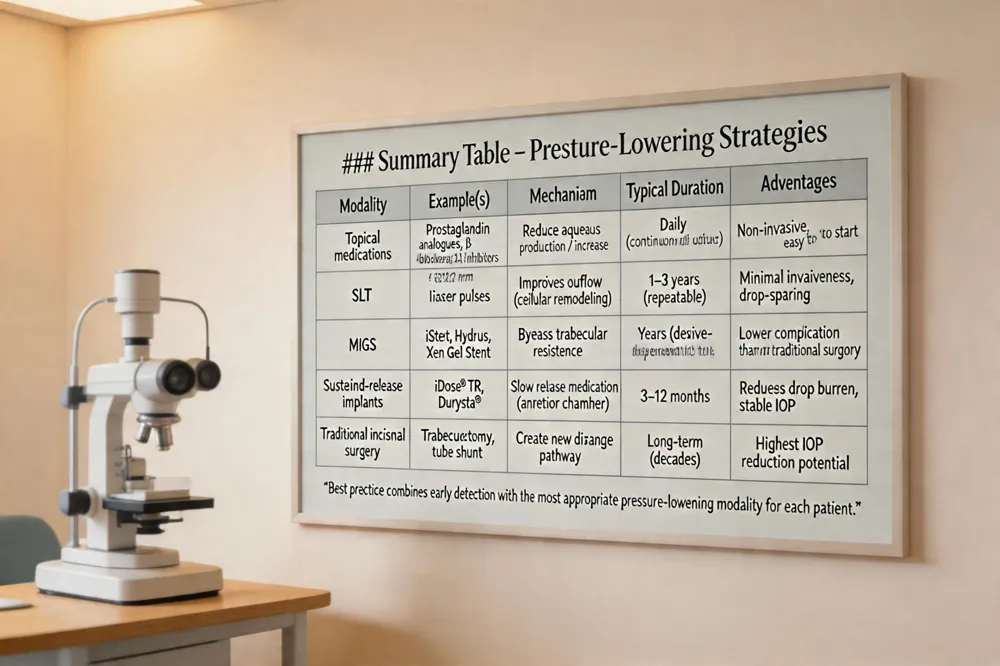
Summary Table – Pressure‑Lowering Strategies
| Modality | Example(s) | Mechanism | Typical Duration of Effect | Advantages |
|---|---|---|---|---|
| Topical medications | Prostaglandin analogues, β‑blockers, carbonic‑anhydrase inhibitors | Reduce aqueous production or increase outflow | Daily (continuous) | Non‑invasive, easy to start |
| Selective Laser Trabeculoplasty (SLT) | 532 nm laser pulses to trabecular meshwork | Improves outflow by cellular remodeling | 1–3 years (often repeated) | Minimal invasiveness, drop‑sparing |
| Minimally Invasive Glaucoma Surgery (MIGS) | iStent, Hydrus, Xen Gel Stent | Bypass trabecular resistance | Years (depends on device) | Lower complication rates than traditional surgery |
| Sustained‑release implants | iDose® TR, Durysta®, biodegradable depots | Slow release of medication intra‑anterior chamber | 3‑12 months (device‑specific) | Reduces drop burden, stable IOP |
| Traditional incisional surgery | Trabeculectomy, tube shunt | Create new drainage pathway | Long‑term (decades) | Highest IOP reduction potential |
Best practice combines early detection with the most appropriate pressure‑lowering modality for each patient.
Best glaucoma treatment in the world
The most effective management blends early detection with personalized pressure‑lowering therapy. In leading centers, minimally invasive glaucoma surgery (MIGS) and sustained‑release implants such as the FDA‑approved iDose® TR are considered gold‑standard because they deliver durable intra‑ocular pressure (IOP) control with fewer side‑effects than chronic drops. Countries with high‑volume expert surgeons—Turkey, Spain, Germany—offer state‑of‑the‑art OCT imaging and lower costs, while Apple Eye Care in El Paso tailors the optimal mix of medication, laser, or surgery for each patient.
Apple Eye Care El Paso
Apple Eye Care, led by Dr. Stephen Applebaum, provides comprehensive eye exams, DRI OCT Triton imaging, and personalized glaucoma management. Services include prostaglandin analogues, fixed‑combination drops, SLT, MIGS, and sustained‑release implants, all delivered with a family‑focused, compassionate approach.
Eye doctor El Paso
The practice offers advanced diagnostics, vision‑correction options, and a full spectrum of glaucoma treatments, ensuring patients receive evidence‑based care in a modern setting.
How to take care of eyes daily
Follow the 20‑20‑20 rule, eat a diet rich in leafy greens and omega‑3s, wear 100 % UV‑blocking sunglasses, practice good lens hygiene, and schedule regular dilated exams.
Avoid these 3 things to protect your vision
- Unprotected UV exposure – wear sunglasses. 2. Prolonged screen time – use the 20‑20‑20 rule. 3. Rubbing eyes – can cause injury and infection.
Which fruit reduces glaucoma?
Berries (blueberries, strawberries) and citrus fruits provide antioxidants that lower inflammation and support optic‑nerve health, reducing glaucoma risk.
5 ways to protect your eyes
- Regular comprehensive exams. 2. UV‑blocking sunglasses. 3. Nutrient‑rich diet (vitamins A, C, E, lutein, zeaxanthin). 4. Screen‑time breaks (20‑20‑20). 5. Protective eyewear for hazardous activities.
10 ways to take care of your eyes
Annual dilated exams, hand hygiene, UV‑blocking lenses, balanced diet, adequate hydration, 20‑20‑20 rule, proper lighting, quit smoking, avoid sleeping in contacts, and use prescribed drops only.
How to protect eyesight naturally
Schedule exams, eat eye‑healthy foods, wear UV protection, stay active, maintain healthy weight, use the 20‑20‑20 rule, keep hands clean, and avoid smoking.
How to prevent vision loss with age
Regular exams, lifestyle control (smoking cessation, blood‑pressure management), UV protection, proper lighting, and personalized care at practices like Apple Eye Care.
Prevention of blindness pdf
The WHO‑based PDF outlines early detection, timely surgery, chronic‑disease management, and training of eye‑care professionals to eliminate avoidable blindness; Apple Eye Care applies these guidelines locally.
How I cured my glaucoma
Early diagnosis at Apple Eye Care, prostlandlandin drops, SLT, lifestyle changes, and regular monitoring halted progression—glaucoma isn’t cured, but it can be effectively managed.
What is the rule of 5 for glaucoma?
A loss of ≥5 µm in average RNFL on consecutive OCT scans signals progression, prompting treatment escalation.
Eyetronic therapy cost
Ten 60‑minute sessions cost $2,000–$3,000 out‑of‑pocket in the U.S.; insurers often do not cover this experimental,. Contact Apple Eye Care for personalized pricing.
Apple Eye Care: Personalized Glaucoma Management in El Paso
Summary Table – Apple Eye Care Services & Innovations
| Service / Innovation | Description | Clinical Benefit |
|---|---|---|
| Comprehensive dilated exams | Full ocular assessment with DRI OCT Triton swept‑source imaging | Early structural detection of glaucoma progression |
| Personalized glaucoma plan | Tailored mix of drops, SLT, MIGS, implants | Optimizes IOP control and patient adherence |
| AI‑driven imaging integration | Training staff on AI analysis of OCT/Fundus | Faster, more accurate progression flagging |
| Home‑monitoring program | Referral to portable tonometers & VR VF tools | Continuous IOP & functional monitoring between visits |
| Neuroprotective trial enrollment | Access to CNTF‑secreting implants & stem‑cell studies | Potential to preserve optic‑nerve health beyond pressure lowering |
| Patient education & lifestyle counseling | UV protection, 20‑20‑20 rule, nutrition guidance | Reduces modifiable risk factors, supports overall eye health |
Apple Eye Care blends cutting‑edge technology with compassionate, family‑focused care to deliver the highest standard of glaucoma management in El Paso.
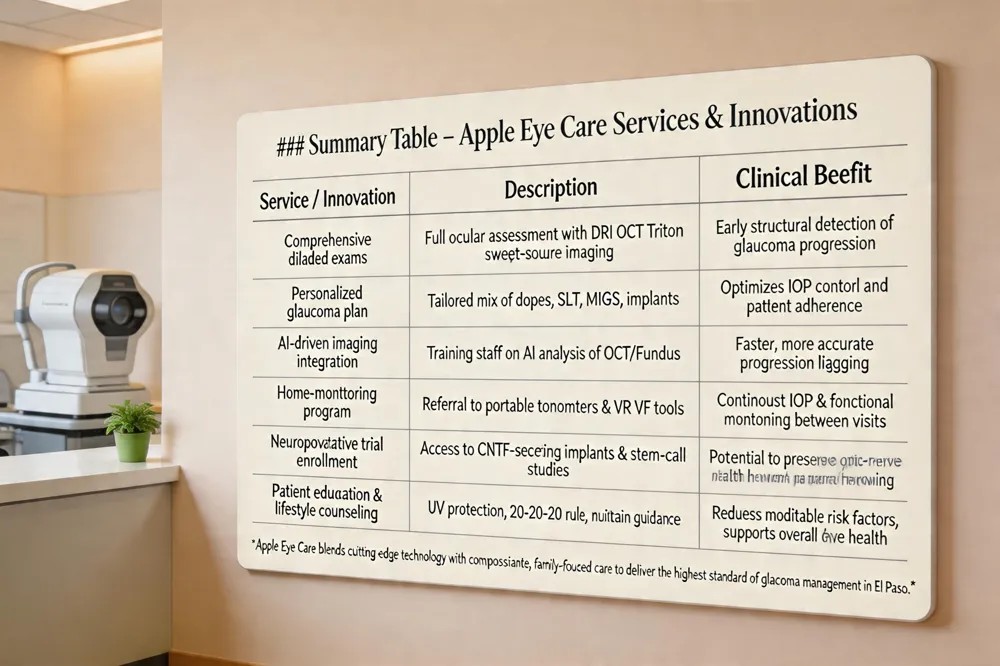 Apple Eye Care in El Paso, TX is a family‑focused optometry practice led by Dr. Stephen Applebaum that delivers compassionate, patient‑centered glaucoma care. Comprehensive dilated eye exams are the foundation of every visit, and the practice utilizes the DRI OCT Triton swept‑source OCT to obtain high‑resolution cross‑sectional images of the optic nerve head and retinal nerve fiber layer. This advanced imaging enables clinicians to detect subtle structural changes early, monitor progression with precision, and tailor treatment plans to each patient’s risk profile.
The clinic’s care model emphasizes empathy and education: staff take time to explain disease mechanisms, medication side‑effects, and lifestyle modifications, while offering personalized options for glasses, contact lenses, and surgical referrals when needed. This approach builds trust and improves adherence, especially for patients who require long‑term IOP‑lowering therapy.
Apple Eye Care is actively preparing for the next wave of glaucoma innovations. By standardizing OCT and visual‑field protocols, upgrading IT infrastructure for data export, and training staff on artificial‑intelligence‑driven imaging analysis, the practice will seamlessly integrate emerging tools such as neuroprotective CNTF‑secreting implants, gene‑therapy approaches, and home‑monitoring tonometry. Early adopters can benefit from these breakthroughs without disrupting workflow or compromising safety.
FAQ
- Apple Eye Care el Paso – A family‑focused practice offering comprehensive exams, DRI OCT Triton imaging, and personalized glaucoma management.
- Eye doctor El Paso – Dr. Stephen Applebaum leads a compassionate team that combines modern diagnostics with individualized care.
- Apple Eye Care el Paso – Same as above; appointments can be scheduled online or by phone for convenient access to cutting‑edge eye health services.
Looking Forward: Protecting Vision One Patient at a Time
Apple Eye Care in El Paso remains devoted to catching glaucoma early through comprehensive dilated exams, OCT imaging with the DRI OCT Triton, and risk‑factor reviews. Each patient receives a personalized plan that blends pressure‑lowering drops, laser or MIGS options, and—when appropriate—emerging neuroprotective strategies such as CNTF‑releasing implants or gene‑reprogrammed astrocytes. The practice continuously integrates AI‑driven imaging analysis and home‑tonometry devices, allowing clinicians to spot progression before symptoms appear. Patients are educated on protective eyewear, UV‑blocking sunglasses, the 20‑20‑20 rule, and nutrition rich in leafy greens and omega‑3s. By pairing cutting‑edge technology with lifestyle guidance, Apple Eye Care empowers individuals to preserve vision and stay ahead of disease. Regular follow‑up visits ensure timely adjustments, reinforcing a patient‑centered approach for vision preservation.