Why a Professional Fitting Matters
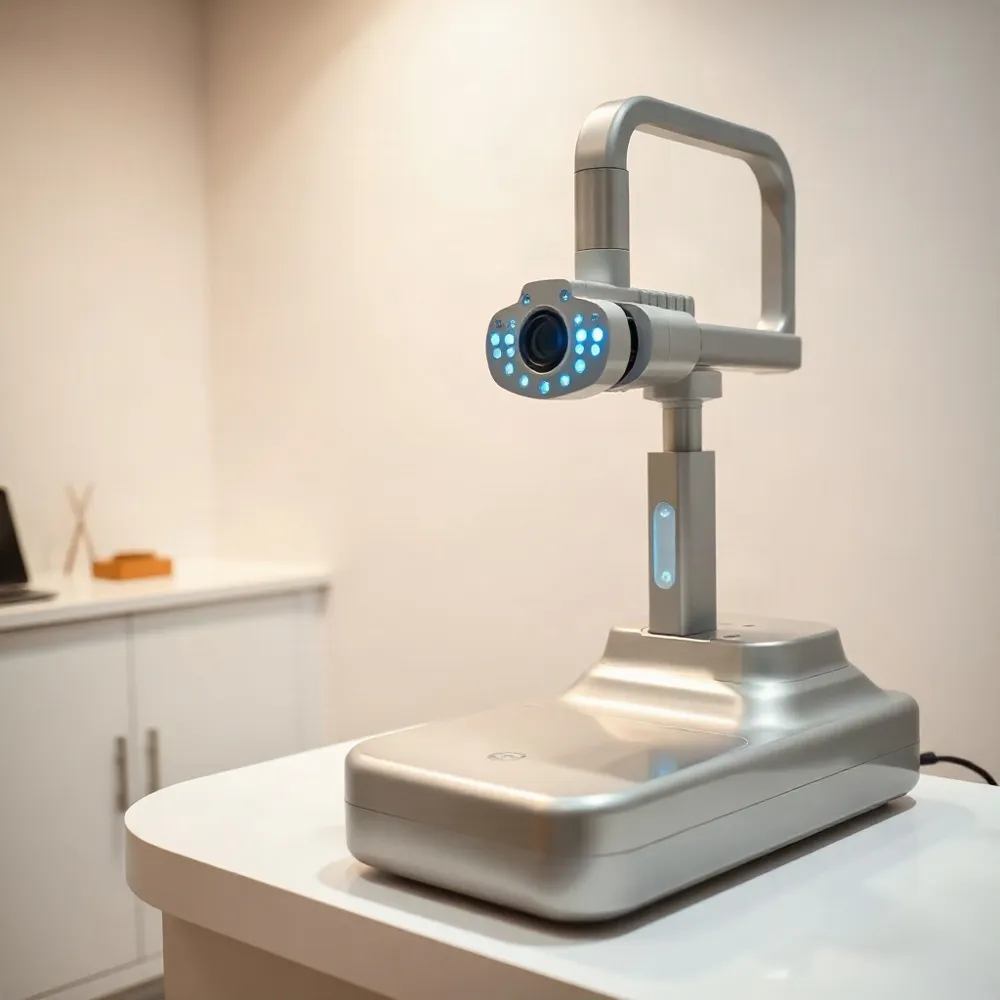
Before any contact lens is placed, a comprehensive eye‑health assessment is performed to rule out infections, dry‑eye disease, or corneal irregularities that could jeopardize comfort and safety. This exam goes beyond a standard vision test, measuring corneal curvature, pupil and iris size, and tear‑film quality with fluorescein or paper strips. Because contact lenses sit directly on the eye, the prescription must include base‑curve, diameter and material specifications—details that glasses prescriptions, which are measured 12 mm away, do not require. Modern practices often employ advanced imaging such as the DRI OCT Triton, which provides high‑resolution maps of corneal thickness and surface topology, allowing clinicians to select the optimal lens design and material for each patient’s unique ocular profile, ensuring long‑term visual clarity and ocular health, and reducing the risk of complications.
Step‑by‑Step Process of a Contact Lens Fitting
Step‑by‑Step Contact Lens Fitting
| Step | Action | Key Evaluation |
|---|---|---|
| 1 | Comprehensive eye‑health exam (vision test, medical history, dry‑eye assessment) | Baseline ocular health and suitability for lenses |
| 2 | Corneal measurements (topography or keratometer, pupil/iris size, tear‑film stability) | Precise curvature, diameter, and tear‑film data |
| 3 | Trial lens placement (short‑wear) | Movement, centration, and visual acuity using slit‑lamp & fluorescein |
| 4 | Hands‑on instruction (insertion, removal, care) | Patient confidence and proper handling |
| 5 | Follow‑up visit (≈1 week) | Comfort, vision clarity, fine‑tuning of parameters |
| 6 | Prescription finalization & after‑care review | Personalized lens prescription and care plan |
| 7 | Annual re‑evaluation | Monitor changes in corneal shape & tear‑film for ongoing safety |
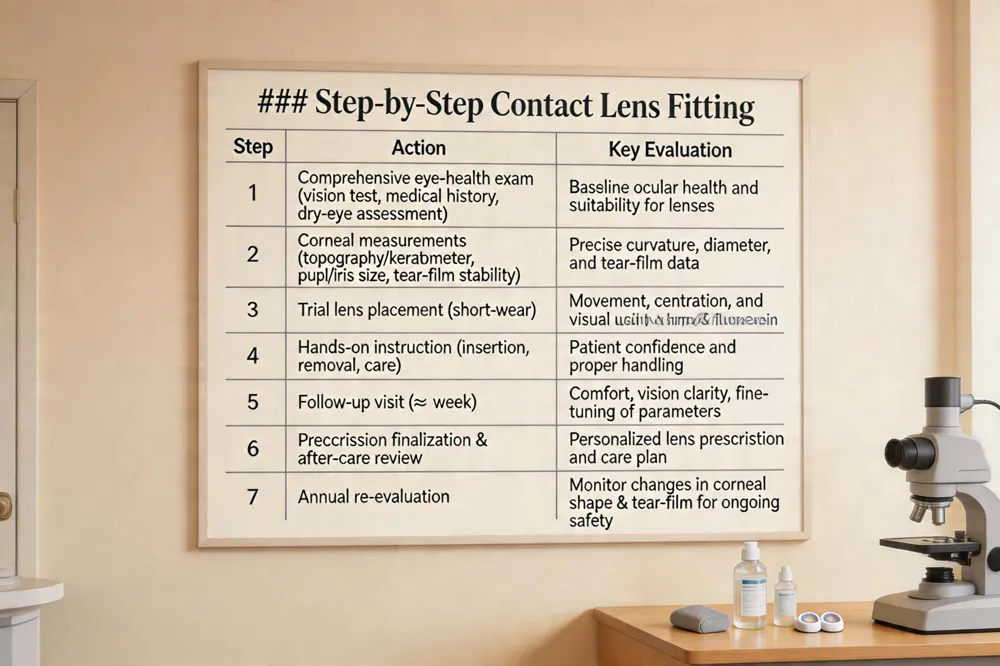 A contact lens fitting begins with a comprehensive eye‑health exam that includes a vision test, review of medical history, and assessment for dry‑eye or other ocular conditions. Using corneal topography or a keratometer (often with DRI OCT Triton), the optometrist measures corneal curvature, pupil and iris size, and tear‑film stability. After these precise measurements, trial lenses are placed on the eye for a short‑wear period; the doctor evaluates movement, centration, and visual acuity with a slit‑lamp and fluorescein dye. Patients receive hands‑on instruction on insertion, removal, and care during this session. A follow‑up visit a week later confirms comfort and vision clarity, allowing any fine‑tuning of lens parameters. Once the fit is optimal, a personalized contact‑lens prescription is written and after‑care guidelines are reviewed. Annual fittings are recommended because corneal shape and tear‑film quality can change, ensuring ongoing safety and comfort.
Key Rules for Comfort and Safety
Key Rules for Comfort & Safety
| Rule | Description | Recommendation |
|---|---|---|
| 3:1:1 TSA liquid rule | Liquids ≤ 3.4 oz (100 ml) in a single quart‑sized bag | Pack only needed solution for travel |
| 20‑20‑20 digital eye‑strain rule | Every 20 min screen time → look 20 ft away for 20 s & blink fully | Reduce eye strain & re‑wet lenses |
| 4‑to‑1 continuous wear rule | Do not wear > 4 continuous hours; take ≥ 1 hour break | Allow corneal re‑oxygenation & prevent irritation |
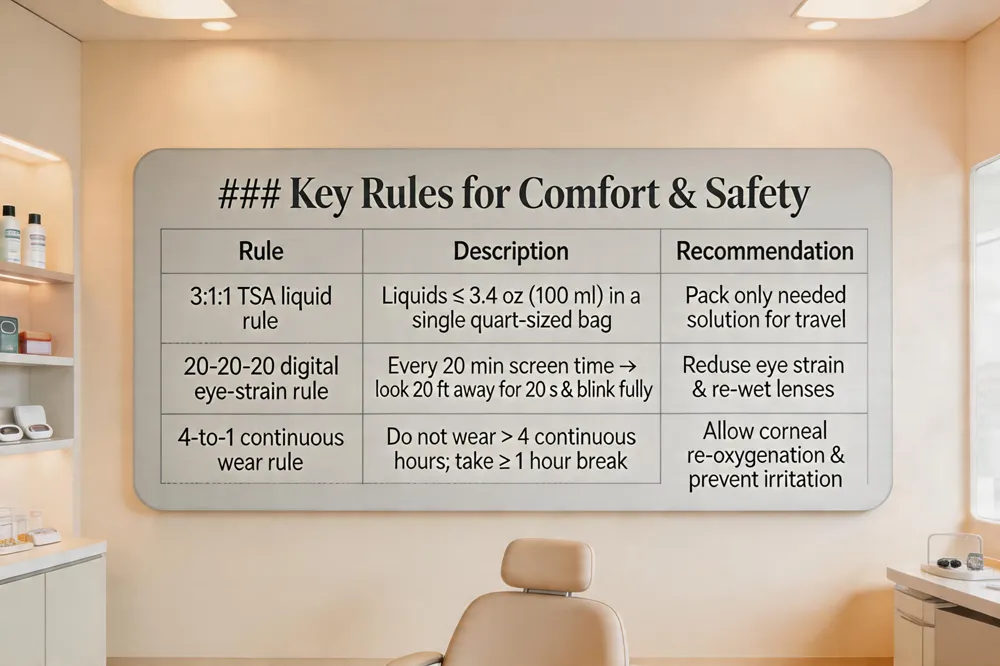 When wearing contact lenses, three simple rules help keep eyes healthy and comfortable.
3:1:1 TSA liquid rule – The TSA limits liquids, including lens solution, to containers of 3.4 oz (100 ml) or less. All containers must fit inside one clear quart‑sized bag. This lets you bring enough solution for travel without delays.
20‑20‑20 digital eye‑strain rule – Every 20 minutes of screen time, look at something at least 20 feet away for 20 seconds and blink fully. The pause relaxes focusing muscles and re‑wetts lenses, reducing dryness and fatigue.
4‑to‑1 continuous wear rule – Do not wear lenses for more than four continuous hours. After four hours, remove them and give your eyes at least a one‑hour break before reinserting. This allows corneal re‑oxygenation and prevents irritation.
Following these guidelines promotes safe, comfortable lens wear.
Cost, Insurance and Payment Options
Cost, Insurance & Payment Summary
| Item | Typical Cost (US$) | Insurance Note |
|---|---|---|
| Comprehensive contact‑lens exam (incl. diagnostics) | $120‑$180 (Apple Eye Care) / $120‑$250 (national 2026) | Often covered; copay $10‑$30 (up to $40) |
| Specialized diagnostics (e.g., corneal topography) | Additional $20‑$50 on top of exam | May be covered depending on plan |
| Glaucoma‑specific testing | Variable; often covered by Medicare Part B, Medicaid, private plans | Copay similar to exam; pre‑authorization may be required |
| Contact‑lens fitting (if separate) | Usually bundled with exam; $0‑$20 if separate | Verify benefits; possible waive for eligible patients |
| Bundle appointment (exam + fitting) | $120‑$180 total | Reduces separate fees; ensure written estimate |
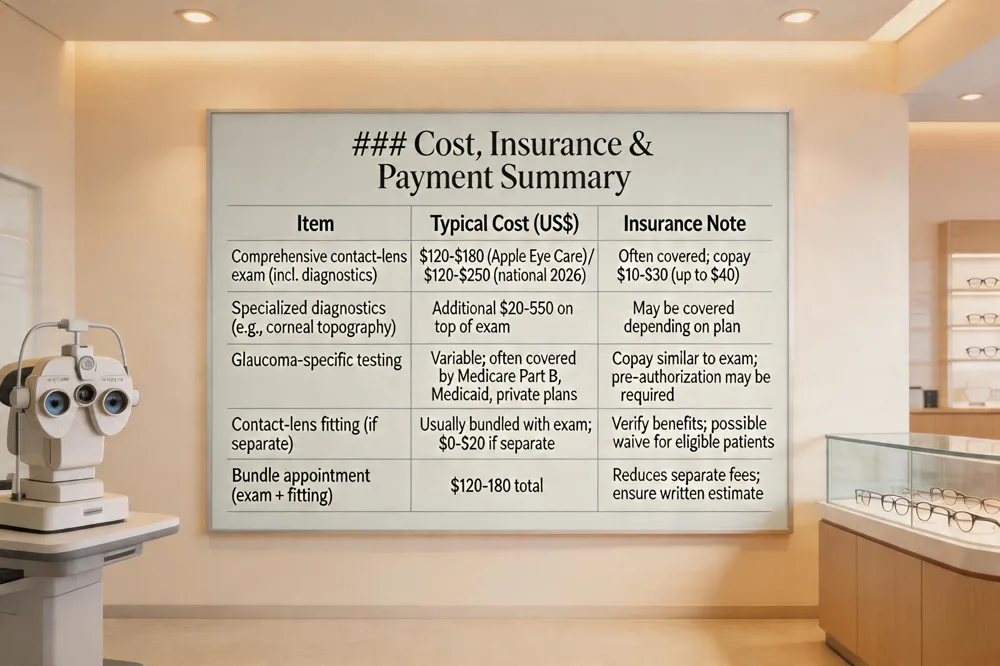 Typical exam price range
A contact‑lens exam at Apple Eye Care in El Paso, TX usually costs $120‑$180 out‑of‑pocket, with the national 2026 range of $120‑$250. Specialized diagnostics such as corneal topography can push the fee toward the higher end.
Typical exam price range
A contact‑lens exam at Apple Eye Care in El Paso, TX usually costs $120‑$180 out‑of‑pocket, with the national 2026 range of $120‑$250. Specialized diagnostics such as corneal topography can push the fee toward the higher end.
Insurance coverage and copays Most vision‑insurance plans cover the exam and fitting, leaving a modest copay of $10‑$30 (up to $40 for some plans). Apple Eye Care verifies benefits and bills the insurer directly, so you know any remaining balance before the visit.
Glaucoma exam considerations Glaucoma does not make exams automatically free, but Medicare Part B, Medicaid, and many private plans cover routine and glaucoma‑specific testing. Apple Eye Care can handle pre‑authorizations and may waive copays for eligible patients.
Tips to avoid extra fees Schedule the fitting on the same day as your routine eye exam, ask for a written estimate, and bring your insurance card to verify coverage. Apple Eye Care bundles the fitting into the comprehensive exam cost for new patients, eliminating separate charges.
FAQs
- How much does a contact lens exam cost at Apple Eye Care? $120‑$180 (or $120‑$250 nationally).
- Are eye tests free if you have glaucoma? Not automatically, but many plans cover them; Apple can help with assistance.
- Is a contact lens fitting covered by insurance? Yes, usually as part of the comprehensive exam with a small copay.
- How much is a contact lens exam without insurance? $120‑$180, higher for specialty lenses.
- How much is a contact lens exam with insurance? Copay $10‑$30, sometimes up to $40.
- How can I avoid extra contact lens fitting fees? Bundle appointments, verify benefits, get a written estimate, and keep insurance documentation.
Specialized Lens Options for Unique Vision Needs
Specialized Lens Options
| Lens Type | Ideal Condition | Key Benefits |
|---|---|---|
| Large‑diameter scleral lenses | Keratoconus, irregular cornea, severe dry‑eye | Vaults over cornea, rests on sclera, fluid reservoir for comfort and vision |
| Custom gas‑permeable (GP) lenses | Early keratoconus, mild irregularities | Tight fit, excellent visual acuity, high oxygen permeability |
| Silicone‑hydrogel / daily‑disposable with moisture tech | Dry‑eye patients | Enhanced wettability, comfortable all‑day wear |
| Toric lenses | Astigmatism | Corrects corneal curvature, stable orientation |
| Multifocal lenses | Presbyopia | Provides near, intermediate, and distance vision in one lens |
| RGP (rigid gas‑permeable) lenses | Mild irregular corneas, high visual demand | Crisp optics, durable, but may be less comfortable than scleral |
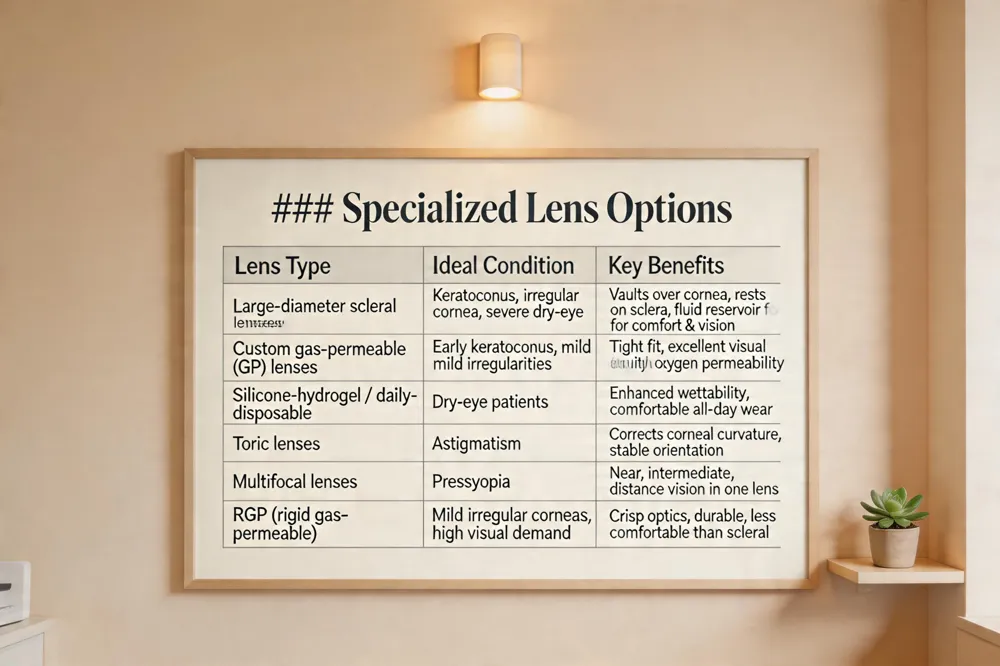 Keratoconus solutions
For keratoconus, the most effective options are large‑diameter scleral lenses and custom‑crafted gas‑permeable (GP) lenses. Scleral lenses vault over the irregular cornea, rest on the less sensitive sclera, and provide a fluid reservoir that eases severe dry‑eye symptoms. Custom GP lenses conform tightly to the corneal shape, delivering excellent visual acuity in early disease. Apple Eye Care’s team, led by Dr. Stephen Applebaum, offers personalized fitting and follow‑up for both lens types.
Keratoconus solutions
For keratoconus, the most effective options are large‑diameter scleral lenses and custom‑crafted gas‑permeable (GP) lenses. Scleral lenses vault over the irregular cornea, rest on the less sensitive sclera, and provide a fluid reservoir that eases severe dry‑eye symptoms. Custom GP lenses conform tightly to the corneal shape, delivering excellent visual acuity in early disease. Apple Eye Care’s team, led by Dr. Stephen Applebaum, offers personalized fitting and follow‑up for both lens types.
Dry‑eye friendly materials Tear‑film evaluation is a core part of any fitting. When dryness is present, silicone‑hydrogel or daily‑disposable lenses with moisture‑enhancing technology are recommended to keep the eye comfortable throughout the day.
Toric and multifocal designs Patients with astigmatism receive toric lenses that the the corneal curvature, while presbyopic individuals benefit from multifocal designs that provide clear vision at multiple distances.
Scleral versus RGP lenses Scleral lenses offer superior comfort by landing on the sclera and creating a stable tear reservoir, making them ideal for irregular corneas and dry‑eye patients. RGP lenses, also called custom GP lenses, provide crisp optics for milder irregularities but may be less comfortable for some wearers. Apple Eye Care evaluates each case to recommend the best fit.
Your Path to Clear, Comfortable Vision Starts Here
Call Apple Eye Care to schedule your contact‑lens fitting, where Dr. Stephen Applebaum’s team uses DRI OCT Triton and corneal topography for precise measurements. Personalized instruction on lens handling and dry‑eye management ensures comfort, so you can enjoy clear, confident vision every day and maintain eye health with follow‑up visits.