Why Vision Matters in Sports
Visual skills are the foundation of athletic performance – roughly 80% of the information an athlete processes during competition comes from the eyes. Dynamic visual acuity, depth perception, peripheral awareness and reaction time directly influence how quickly a player can locate a ball, judge its trajectory, and execute the appropriate motor response. Studies show that elite baseball players have about 30% better distance visual acuity than non‑athletes, and a 2024 six‑week vision‑training program produced a 12% boost in on‑field decision‑making speed. Regular vision training and comprehensive eye exams can cut sports‑related eye‑injury risk by up to 30% and improve visual processing speed by as much as 20%. In short, sharpening the brain‑eye connection translates into faster decisions, more accurate movements, and a measurable competitive edge on the field, court, or track.
Evidence‑Based Benefits of Sports Vision Training
Key Evidence‑Based Benefits
| Benefit | Reported Improvement | Typical Study Duration |
|---|---|---|
| Decision‑making speed | +12 % | 6 weeks (controlled trial) |
| Reaction time | +15‑20 % (dynamic visual acuity) | 8‑12 weeks (meta‑analysis) |
| Depth perception | +15‑20 % | 8‑12 weeks |
| Peripheral awareness | +15‑20 % | 8‑12 weeks |
| Eye‑injury reduction | ↓ up to 30 % | Ongoing training |
| Hand‑eye coordination | +15‑20 % | 8‑12 weeks |
Sources: 2024 controlled trial, systematic reviews of 126 studies, meta‑analyses.
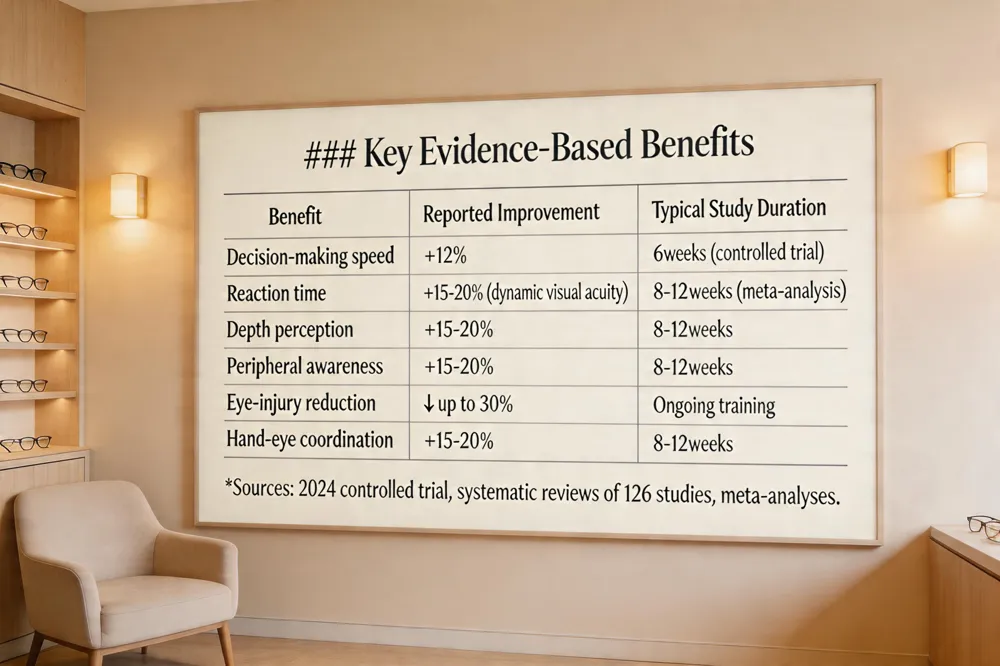 Research consistently shows that sports vision training (SVT) works. A 2024 controlled trial reported a 12 % boost in decision‑making speed after six weeks of targeted drills, while systematic reviews of 126 studies link SVT to measurable gains in reaction time, depth perception, and peripheral awareness. Meta‑analyses highlight that dynamic visual acuity and eye‑hand coordination improve by 15‑20 % on average, translating into faster, more accurate sport‑specific actions such as batting or passing.
Injury‑prevention data also support SVT: regular eye‑exam‑based training reduces sports‑related eye injuries by up to 30 %, and enhanced visual reaction time helps athletes avoid collisions on the field. Advanced diagnostics—like the DRI OCT Triton and wavefront analysis used at Apple Eye Care in El Paso, TX—allow optometrists to identify deficits and tailor programs that combine in‑office equipment (Fitlight boards, strobe lights) with home drills (Yes‑Yes/No‑No, Follow the Light, peripheral awareness).
Apple Eye Care integrates these evidence‑based protocols into comprehensive optometry services, ensuring athletes receive both health screening and performance‑focused vision therapy for optimal visual efficiency
Home‑Based Drills, Apps and Online Platforms
Home‑Based Tools & Resources
| Tool | Type | Primary Skill Targeted | Approx. Cost |
|---|---|---|---|
| Yes‑Yes/No‑No fixation | Drill | Convergence & accommodation | $0 (no equipment) |
| Pencil push‑ups | Drill | Near‑far focus shifts | $0 |
| Vision Training & Eye Exercise (app) | Mobile app (28+ games) | Depth perception, reaction speed | $4.99/mo |
| Vision Workout (app) | Mobile app (Teleportation, Zigzag) | Tracking, visual memory | $3.99/mo |
| RightEye Sports Vision Video Library | Web‑based library (140+ videos) | Full skill suite | $29/yr |
| Vizual Edge | Web platform (15‑min 3D drills) | Dynamic acuity, peripheral awareness | $19/mo |
| Strobe glasses | Equipment | Temporal resolution | $30‑$45 |
| Flashlight (pursuit‑saccadic) | Simple tool | Eye‑movement speed | $5 |
| Straw‑through‑object depth tool | DIY | Depth perception | $2 |
All tools are designed for ≤ $50 per item, making visual training accessible.
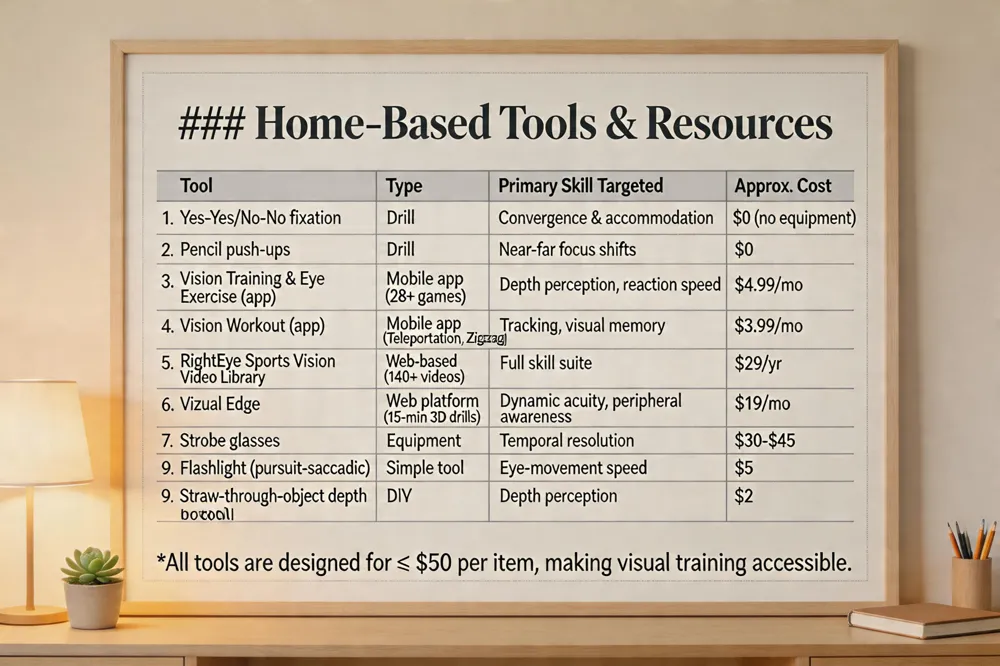 Home‑based drills, apps and online platforms let athletes train the visual skills essential for sport. Eye‑muscle fitness routines—Yes‑Yes/No‑No fixation, pencil push‑ups, figure‑8 tracking—improve convergence, accommodation and peripheral awareness without a clinic. Mobile apps such as Vision Training & Eye Exercise (28+ guided games) and Vision Workout (Teleportation, Zigzag, MOT Skills) deliver three‑minute daily sessions that boost depth perception, reaction speed and visual memory. Web‑based libraries like RightEye’s Sports Vision Video Library (140+ videos) and Vizual Edge (15‑minute 3D drills) provide tutorials and progress tracking. Affordable equipment includes inexpensive strobe glasses, a flashlight for pursuit‑saccadic drills, and a simple straw‑through‑object depth‑perception tool—each under $50.
Sports‑vision training apps: Vision Training & Eye Exercise and Vision Workout give gamified exercises targeting convergence, peripheral awareness, tracking and reaction time.
What are sport vision exercises? They are specialized activities—focus‑flexibility, peripheral‑awareness, depth‑perception, pursuit and saccadic drills—prescribed by an optometrist to enhance eye‑brain coordination, reaction time and coordination.
Sports vision training online: Platforms such as RightEye, Vizual Edge, Vision Training Lab and EyeQ deliver tutorials, exercises and progress monitoring, allowing athletes to train at home while receiving optometrist feedback.
Sports vision training equipment: Strobe glasses, 3‑D vision trainers, reaction‑light systems and inexpensive tools like flashlights, straws and figure‑8 charts provide ways to sharpen visual processing and coordination.
Professional Guidance, Certification and Comprehensive Care
Certification & Professional Pathways
| Certification Body | Program Length | Core Components | Typical Cost |
|---|---|---|---|
| Sports Vision Professionals Academy | 6‑month (online + labs) | Optometry basics, vision therapy, sport‑specific protocols | $2,500‑$3,200 |
| College of Optometrists in Vision Development | 9‑month (blended) | Advanced diagnostics, patient management, research methods | $3,000‑$4,000 |
| Apple Eye Care (in‑house) | Ongoing | DRI OCT Triton, custom drills, insurance navigation | Included in treatment plan |
All programs require a passing exam and practical competency assessment.
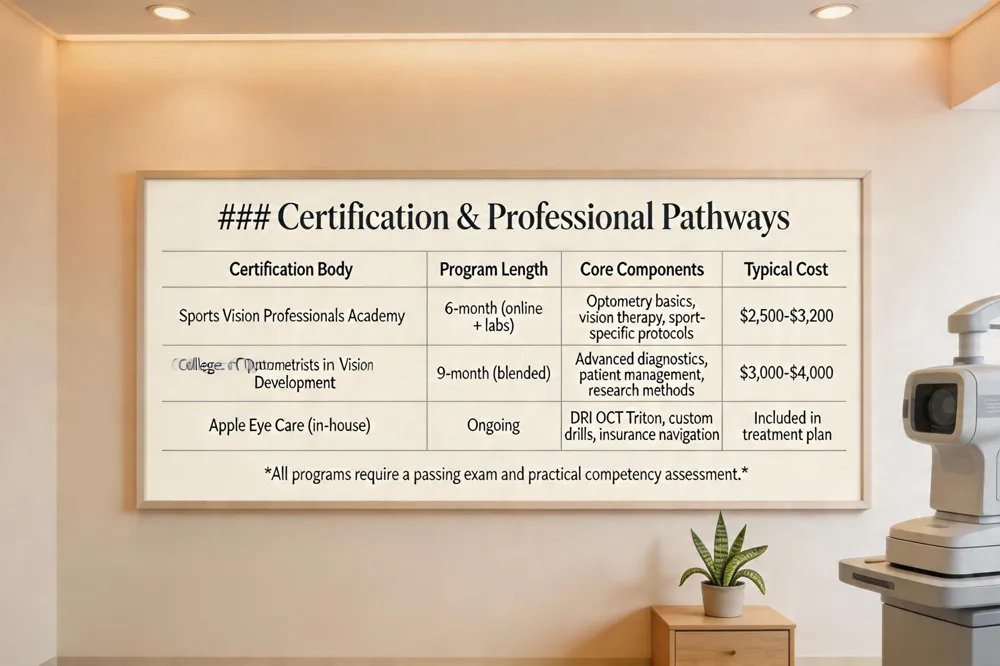 Sports vision training certification is offered through specialized academies such as the Sports Vision Professionals Academy and the College of Optometrists in Vision Development. These programs combine online coursework, practical labs, and testing to ensure clinicians can assess and prescribe sport‑specific visual programs. A comprehensive eye exam with a sports‑vision specialist first identifies refractive errors or binocular issues. After the exam, a personalized therapy plan—including "yes‑yes/no‑no" head‑movement drills, pursuit and saccadic light‑tracking, focus‑flexibility or near‑far switches, reaction‑time wall‑ball catches, and depth‑perception straw drills—trains eye muscles, improves fixation stability, dynamic visual acuity, peripheral awareness, and hand‑eye coordination. Sports vision therapy (SVT) at Apple Eye Care uses advanced diagnostics like the DRI OCT Triton to create customized in‑office and at‑home programs, helping athletes maintain focus under fatigue and make faster decisions. Vision therapy can indeed boost sports performance by strengthening eye‑tracking, depth perception, and reaction time, reducing visual fatigue and enhancing confidence. Insurance coverage varies; medical plans may reimburse therapy when prescribed for medical conditions, while vision plans often do not. Patients can use HSA/FSA funds or discuss payment options with Apple Eye Care’s billing staff before starting treatment. Printable exercise PDFs are available from professional bodies and can be personalized by the Apple Eye Care team.
Elite Athletes Share Their Visual Success Stories
Visual Metrics of Elite Athletes
| Sport | Typical Visual Acuity | Reaction Time Gain | Notable Drill |
|---|---|---|---|
| Baseball | 20/13 or better | 15‑20 % faster | Wall‑ball, VR “Portals” |
| Basketball | 20/15 | 10‑12 % faster | Laser‑grid, peripheral scans |
| Soccer | 20/14 | 12‑15 % faster | Near‑far focus, strobe glasses |
| Tennis | 20/12 | 15‑18 % faster | Fitlight boards, pursuit drills |
| Archery | 20/13 | 10‑12 % faster | Straw‑through‑depth tool |
These figures reflect improvements after 8‑10 weeks of structured sports‑vision programs.
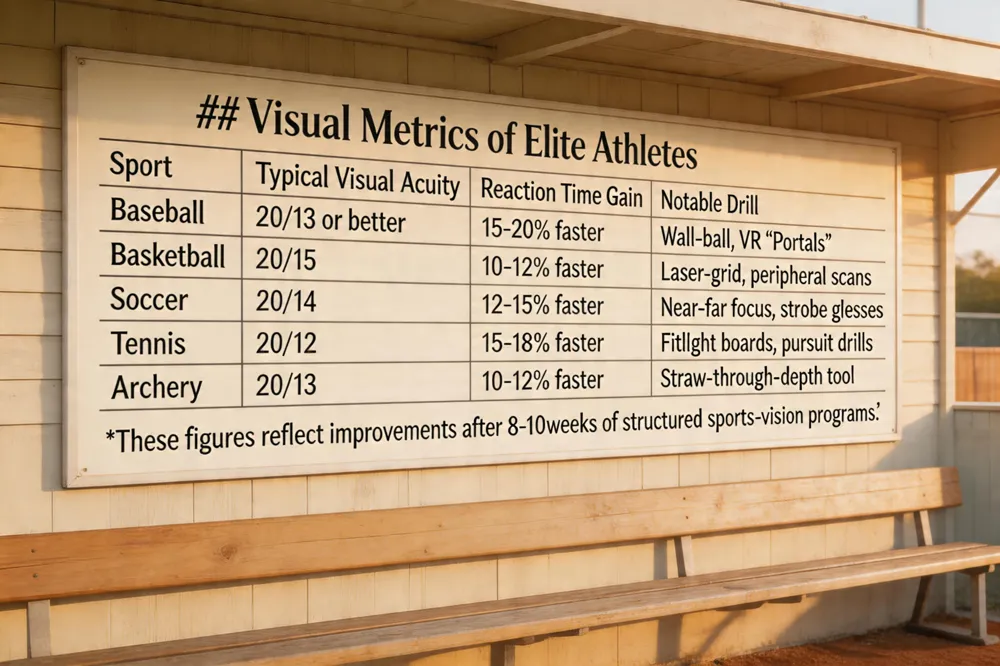 Elite athletes train their eyes with structured sports‑vision programs that blend high‑intensity drills and technology‑driven simulations. Dynamic visual acuity, visual reaction time, and hand‑eye coordination are honed using wall‑ball, laser‑grid, and VR “Portals” drills, while peripheral awareness and depth perception exercises—such as near‑far focusing with straws and pebbles—sharpen spatial judgment. Proprioceptive eye‑tracking workouts engage extra‑ocular muscles, creating a brain‑eye‑body connection that lets athletes perceive fast actions in “slow motion,” leading to quicker, more accurate decisions on the field.
Vision is a primary determinant of athletic performance, accounting for up to 80 % of success in many sports. Professional baseball players often achieve visual acuity better than 20/13, enabling split‑second detection of pitches. Depth perception, peripheral awareness, and hand‑eye coordination support precise timing for catching, diving, or shooting, while fast visual processing reduces reaction time and enhances anticipatory skills.
Sports vision training benefits most from sport‑vision training include baseball, softball, basketball, soccer, football, hockey, golf, and tennis—any discipline that requires rapid tracking, accurate distance judgment, and wide‑field awareness. Even individual activities such as archery, skiing, and martial arts see performance gains when visual processing speed and spatial awareness are sharpened.
For athletes in El Paso, TX, Apple Eye Care offers comprehensive sports‑vision testing and personalized training plans. Led by Dr. Stephen Applebaum, the practice uses advanced diagnostics like the DRI OCT Triton to identify visual deficits and prescribe targeted drills, corrective lenses, and performance eyewear that reduce glare, enhance contrast, and protect against dry‑eye symptoms. Regular follow‑up ensures visual skills continue to support peak athletic performance.
Integrating Vision Training Into Athletic Programs
Typical 8‑10‑Week Vision Training Program
| Week | In‑Office Sessions (min) | Home Drills (min/day) | Focus Area |
|---|---|---|---|
| 1‑2 | 30 (baseline assessment, intro drills) | 10 (Yes‑Yes/No‑No, Follow the Light) | Convergence & fixation stability |
| 3‑4 | 35 (Fitlight, strobe) | 12 (pencil push‑ups, peripheral scans) | Dynamic visual acuity |
| 5‑6 | 40 (wavefront‑guided exercises) | 15 (near‑far focus, depth‑perception straw) | Depth perception & reaction time |
| 7‑8 | 45 (VR “Portals”, advanced tracking) | 15 (mixed drills) | Hand‑eye coordination |
| 9‑10 | 30 (re‑test, program adjustment) | 10 (maintenance) | Skill consolidation |
Frequency: 2‑3 in‑office sessions per week; daily home practice.
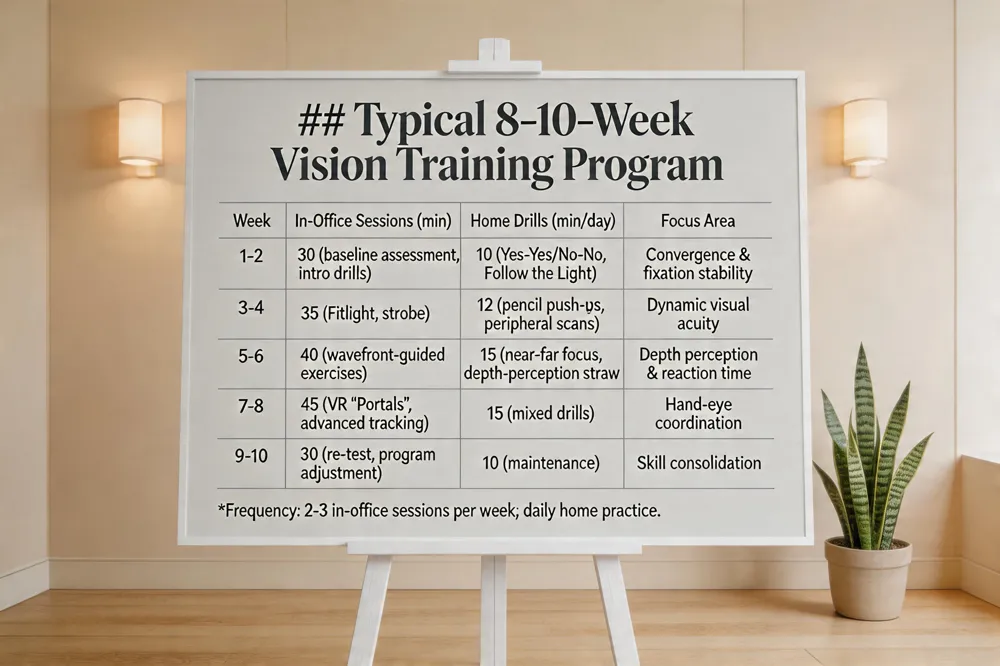 Effective sports‑vision programs weave eye‑muscle fitness into the broader training schedule, ensuring that visual drills complement physical conditioning. Most athletes follow an 8‑10‑week plan with 2‑3 sessions per week, each lasting 30‑45 minutes, while continuing at‑home drills such as the Yes‑Yes/No‑No fixation exercise and Follow the Light pursuit drills.
How long does sports vision training take?
Programs are typically designed for a two‑month window, delivering measurable gains in reaction time, peripheral awareness, and hand‑eye coordination. Duration can be adjusted based on baseline visual skill, sport‑specific demands, and compliance with home practice.
What is the success rate of vision therapy?
Research shows a 70‑80 % success rate for improving binocular‑vision deficits and related performance metrics when office‑based therapy is combined with regular home exercises.
Sports vision optometry salary
In the United States, sports‑vision optometrists earn roughly $120,000‑$180,000 annually, reflecting the specialized expertise required for performance‑focused care.
Sports vision therapy exercises
Key drills include pencil push‑ups/near‑far focus shifts, peripheral‑awareness scans, and depth‑perception tasks using a straw or small objects. Technology‑assisted drills (Fitlight boards, strobe glasses further hone dynamic visual acuity and reaction speed.
Monitoring progress involves baseline assessments (dynamic acuity, reaction time, tracking accuracy) and periodic re‑testing, allowing coaches and optometrists to adjust the program and ensure that visual gains translate into on‑field decision‑making speed and reduced injury risk.
Choosing Apple Eye Care for Your Sports Vision Needs
Apple Eye Care – Service Overview
| Service | Description | Benefit |
|---|---|---|
| Comprehensive eye exam | Full refractive & binocular assessment | Baseline visual health |
| DRI OCT Triton imaging | High‑resolution retinal & ocular surface scan | Precise deficit identification |
| Custom sport lenses | Prescription glasses/contacts with anti‑fog, anti‑scratch, UV coating | Enhanced contrast & glare reduction |
| In‑office vision therapy | Fitlight boards, strobe lights, wavefront analysis | Rapid skill acquisition |
| Home‑drill program | Yes‑Yes/No‑No, Follow the Light, peripheral scans | Skill retention & transfer |
| Progress monitoring | Regular re‑testing (dynamic acuity, reaction time) | Objective performance tracking |
All services are tailored for athletes in El Paso, TX.
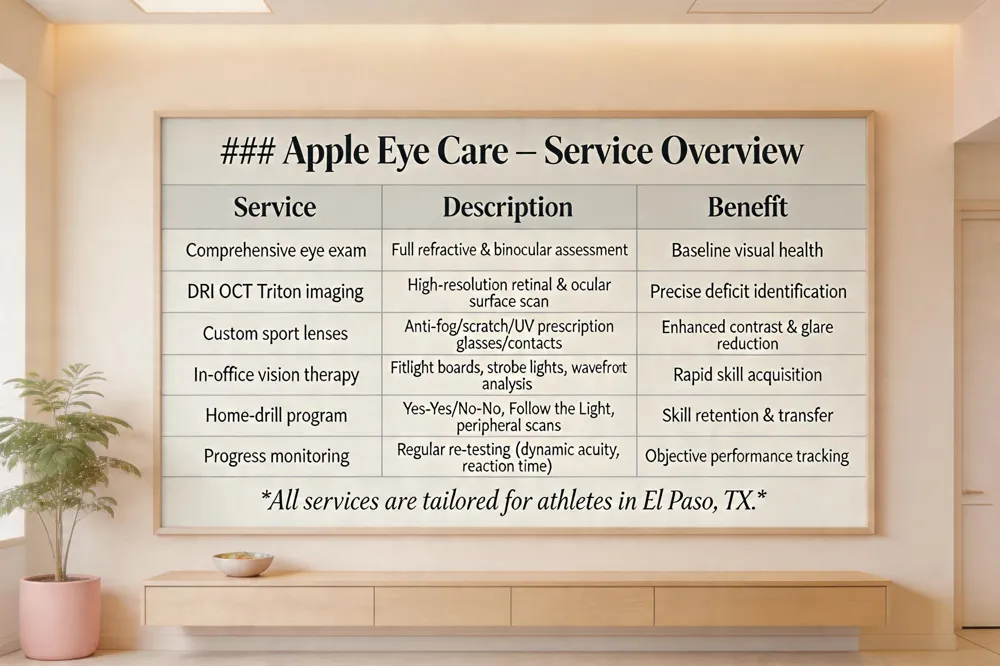 Apple Eye Care, a family‑focused optometry practice in El Paso, TX, provides local expertise for athletes seeking to sharpen their visual game. The team, led by Dr. Stephen Applebaum, offers comprehensive eye exams, vision correction, and advanced diagnostics such as the DRI OCT Triton, allowing precise assessment of retinal health and ocular surface conditions that can affect high‑impact sports.
Vision Performance Wear – With detailed vision assessments, Apple Eye Care custom‑fits sport‑specific glasses and contact lenses that reduce glare, enhance contrast, and protect against UV and dry‑eye challenges. Prescription lenses can be paired with anti‑fog and anti‑scratch coatings to keep athletes focused during intense competition.
Eye Exercises to Remove Glasses – While eye‑muscle drills (e.g., the 20‑20‑20 rule, near‑far focusing, figure‑eight tracing) support eye‑health and may lessen strain, they do not correct refractive errors. For lasting clear vision, a professional exam and appropriate corrective lenses remain essential.
Sports Vision Training Near Me – Athletes in the El Paso area can access personalized sports‑vision training at Apple Eye Care. Using tools like the DRI OCT Triton, the practice identifies visual‑skill deficits and designs customized in‑office and at‑home programs that improve reaction time, depth perception, peripheral awareness, and eye‑tracking. Appointments are available online or by phone, ensuring a seamless path to enhanced athletic performance.
Putting Vision at the Heart of Athletic Success
Sports‑vision training delivers measurable gains: faster decision‑making, sharper tracking, improved depth perception, and reduced injury risk. A 2024 study showed a 12 % boost in on‑field decision speed after just six weeks, while regular vision drills cut sports‑related eye injuries by up to 30 %. For athletes, the message is clear—incorporate vision assessments and customized drills into every training cycle. Schedule a comprehensive eye exam, then work with a specialist such as Dr. Stephen Applebaum at Apple Eye Care in El Paso, TX, to design a sport‑specific program that blends in‑office technology (DRI OCT Triton, Fitlight, strobe lights) with daily home exercises like “Yes‑Yes/No‑No,” pursuit drills, and peripheral awareness. Looking ahead, emerging VR/AR platforms and real‑time eye‑tracking analytics promise even more precise, sport‑tailored training, making vision a permanent pillar of athletic performance.